

I’ve long been a fan of Elon Musk because of his incredible accomplishments and his work ethic, so I’ve certainly paid a lot of attention to what he’s been doing and saying in the past. However, on top of that, I just got back from a vacation in Phoenix and while I was there and traveling to-and-fro, I took the opportunity to read, “The Book of Elon: A Guide to Purpose and Success” and I spent more than 20 hours listening to Walter Isaacson’s fascinating Elon Musk autobiography, which I think is highly likely to make a extrtaordinary mini-series one day.
After consuming all of this, it felt possible to condense the essence of Elon Musk’s success down to a very small number of thoughts and quotes that can be extraordinarily useful in the lives of a lot of people. That goes double because, contrary to what you may have heard, he did not start by being “rich.” When he was eighteen years old, Elon was working an $18 per hour job. Of course, that doesn’t mean absorbing these ideas will turn you into Elon Musk.
Musk has an extremely high IQ. His actual IQ has never been released, but as someone who has been around some extraordinarily gifted intellects throughout his life, my guess would probably be in the 160-170 range.
Musk has also taken an enormous number of highly aggressive risks in his life, where the odds were heavily against him, and somehow, someway, he has beaten the odds over and over again. Are his extraordinary talent, work ethic, and leadership skills part of that? Yes, but he’s also clearly had some incredibly good luck. That’s not discounting his accomplishments, it’s just acknowledging he has been within a hair’s breadth of failure multiple times. Musk himself has said this.
“There have been many times where I expected to lose everything. Who starts a car company and a rocket company expecting them to succeed? Certainly not me. I thought they both had a low chance of success, less than 10 percent. Maybe 1 percent, I don’t know.”
It’s also worth noting that Elon Musk is a guy who lives to work, pushes himself, and tries to do big, impossible things. That may be a recipe for incredible accomplishment, but it’s not necessarily a roadmap to a happy, balanced life, although he certainly seems to love his kids, has people in his life who care about him, and he certainly has more than a few good and cheerful days.
So, keep all that in mind and then start soaking in these quotes and thinking about how you can apply them to your life. None of the rest of us can be Elon, but what we learn from him may take us a lot further in life than we would have gone otherwise.
1) “A maniacal sense of urgency is our operating principle.” Musk’s philosophy is to get brilliant engineers, push them to the absolute limit of what they can do every day, and then, when they eventually burn out, replace them with another great engineer who he will also push to the limits. Musk does not believe in “balance” or “pacing,” he believes that EVERY DAY is a race against the clock for himself, his companies, and his employees. As the Romans said:

All of us only have so much time. Musk would tell you to get hardcore about making the most of it.
2) “Optimism, pessimism, f*ck that. We’re going to make it happen. As God is my bloody witness, I’m hell-bent on making it work.” One thing you will see over and over again with Elon Musk is that he will think about something that’s desperately needed or what he believes is the right way to design something, and then he will set out after it, even if people say it’s not unrealistic. Does it always work? No. But still, time and time again, he’s pulled a rabbit out of his hat and done something nobody thought he could do because he put everything he and his team had into trying to do something that looked impossible. What is there in your life that you’re willing to pour EVERYTHING into to make it happen?
3) “If you’re not adding deleted things back in 10 percent of the time, you’re clearly not deleting enough. Somewhat illogically, people often feel they’ve succeeded if they are not forced to put anything back in. But actually, they have failed in a different way, because they’ve been overly conservative and have left things in there that shouldn’t be.” Elon very much believes in aggressively optimizing and trying new things that may or may not work. If you have that philosophy, you’re going to make mistakes. You’re going to screw things up. You’ll fail sometimes. However, over the long haul, you’re also going to get 10 times further than the people who never experimented and took any risks at all.
4) “For internal timelines, we set the most aggressive timelines we can. I do this because there’s a kind of ‘law of gaseous expansion’ for schedules. Whatever time you set, it’s not going to be less than that. It’s rare that something will ever get done faster than the schedule.” Elon is famous for his aggressive deadlines, and often, he misses them. However, the fact that he is always pushing his people to do much more than they think, faster than they think is possible, has enabled him to do a lot of things most people never thought they could do in the first place. What could you do if you set a big goal and pushed yourself to hit it faster than you think is possible?
5) “But there’s something else I’ve found this year. It’s that fighting to survive keeps you going for quite a while. When you are no longer in a survive-or-die mode, it’s not that easy to get motivated every day.” Musk is someone who always seems to have some kind of powerful external motivation, even if he has to create it himself. He pushes for heroic goals, sets arbitrary deadlines, makes himself the point person for every crisis in his companies, and convinces himself that the success of humanity in some areas is dependent upon his getting one of his companies to a certain goal. This keeps him pushing, working, and driven far beyond what most other human beings can manage. What is pushing you to go further and faster than you thought you could?
6) “All bad news should be given loudly and often. Good news can be said quietly and once.” One of the keys to Elon’s success is that he applies himself to whatever the hardest problem is at his companies. If there’s a big problem people don’t know how to solve, that’s where Elon will be. Eventually, if you fix enough problems, you will succeed practically by default.
7) “I think it’s a real weakness to want to be liked. A real weakness. And I do not have that.” Elon Musk expects excellence at all times in his companies, and if his standards are not met, he does not let it slide. To him, the mission is everything, and friendships, “being nice,” or babying people along are nothing. Not everyone can or should try to do that, but there is something to be said for doing what you think is right even if the whole world disagrees with you.
8) “If your hand is on a stove and it gets hot, you pull it right off. But if it’s someone else’s hand on the stove, it will take you longer to do something about it.” Elon very much believes in collapsing boundaries between departments and layers of management in his companies. He wants the engineers to create the products right next to the people assembling and installing them. The more everyone can talk to each other and see what each other’s problems are, the easier problems become to solve.
9) “If there was a crisis situation, I slept on the floor. Most of the time, I did not sleep in a conference room because people could not see me in the conference room—I slept on the floor in the factory. Otherwise, how would people know? They wouldn’t. Seeing is believing. I slept on the floor outside the conference room so they could see I was there. When the team is being asked to work super hard, I have to be right there with them, and they have to see it. If I fall asleep in the middle of the factory floor at four in the morning and wake up four hours later, they see that. They are like, ‘If the CEO is willing to take that level of pain, I can do it too.’” It’s true that Musk asks AN ENORMOUS AMOUNT out of his employees, but he also leads from the front in a crisis. If he’s asking an employee at Tesla or SpaceX to give everything they have in some urgent push, they will see him walking around on the floor and yes, even SLEEPING WHERE THEY CAN SEE HIM, so they know he’s right there with them. There’s a lot to be said for never asking people to do something that you wouldn’t do yourself.
10) “For any company, ask, ‘Are the efforts we’re expending resulting in a better product or service?’ If they’re not, stop those efforts.” This feels like another way of saying Stephen Covey’s famous quote:
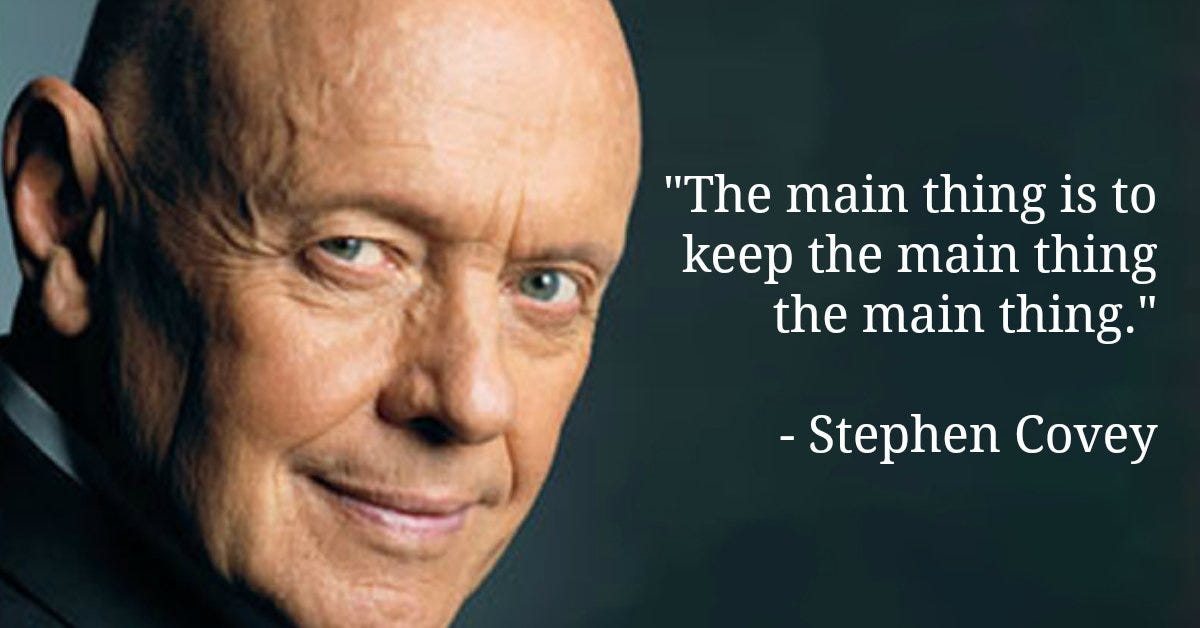
Never lose sight of what matters most in your life and keep your focus there.
11) “I don’t look at ideas and ask, ‘What is the rank-ordered list of best business opportunities from a financial standpoint?’ I look for problems that are important to fix for people now and for the future to be good.” This is one of the most amazing things about Elon Musk. In pretty much every case, he’s started a business to tackle what he thinks is an important problem for humanity, and he’s figured out how to make it profitable later. Imagine what the world would look like if all of us started trying to figure out how to do things that benefit everyone else first and then figured out how to get rewarded ourselves later.
12) “The other way to think is to imagine the Platonic ideal of the perfect product or technology. What is the perfect arrangement of atoms that would be the best possible product? Now try to figure out how to get the atoms in that shape. Think through things in both directions. What can we build with the tools that we have? But also, what does the “theoretically perfect” product look like? The idea of the “theoretically perfect” product is going to be a moving target because, as you learn more, the definition for that perfect product will change. You don’t actually know what the perfect product is, but you can approximate a more perfect product. Then ask, ‘What tools, methods, or materials do we need to create to get the atoms in that shape?’ People rarely think this way.” Elon uses this technique as a way to work backward from the ideal to make his products today better, but it’s also a powerful way to improve your life. What is your perfect life? What would it look like if it were as good as possible? Once you envision that, you can start working backward to think about how to make it more like that today. Some people find that scary or frustrating, but Elon believes that if, for example, he can think about what a rocket that goes to Mars will need to look like to make it possible, he can make little changes today to make his rockets better, and over time, it will help lead him to his ultimate goal.
13) “The most common mistake of smart engineers is to optimize a thing that should not exist.” In Elon’s view, everything should be as easy, simple, and fast as possible. He ruthlessly optimizes everything to do this. Over the long haul, this saves enormous amounts of money, effort, and time. How many of us fail to do this in our own lives and spend time trying to fix, adapt to, or work around something we shouldn’t be doing in the first place?
14) “Better to pick a path and keep moving than just vacillate endlessly on a decision.” Elon Musk is someone who is willing to make decisions, even when they’re hard, even when smart people disagree, even when he knows they may be wrong. If he gets new information, he may change his mind, but he understands that being indecisive has a high price to it. It paralyzes you, squanders momentum, and can drag on endlessly. Just make a decision, move forward decisively, and then at least something good may happen. Nothing good will ever happen until you make a decision.
15) “That first-principles thought process around the rocket became general purpose for all parts. I call it the ‘Idiot Index.’ How much more does a finished product cost than the cost of its materials? If a part or product had a high Idiot Index, we could cut the cost with more efficient manufacturing techniques. A component that costs $1,000 when the aluminum it was made of costs only ten dollars likely has a design that is too complex or an inefficient manufacturing process. If the ratio is high, you’re an idiot.” The “Idiot Index” is particularly useful for manufacturing, but the idea of going back to first principles is useful across your entire life. What are your dreams? What are your goals? What are your core beliefs? What are your beliefs about how the world works? Are the things you’re doing on a day-in, day-out basis aligned with those things? If not, Elon would probably tell you that you’re doing something wrong.
Bewilderingly poignant.