

Everyone has different rules, mental shortcuts, habitual behaviors, and expectations for how things will play out when they’re around other humans.
These are mine, and unfortunately, I had to learn some of them the hard way.
Hopefully, as you read over these, you’ll see a few that you can add to your own personal code.
1) The opinions of people online who aren’t your friends or someone you respect don’t matter very much. They certainly should never be allowed to impact your mood negatively.
2) If you genuinely screwed up, apologize unless you’re dealing with an online mob. You never apologize to the mob.
3) If you’re under 30 and not a stone-cold expert in something I’m asking you about, I do not need your advice.
4) Put the shopping cart back. Rack the weights. Pick up your dog’s sh*t.
5) Doing or saying something dumb in response to something dumb does not make you smart.
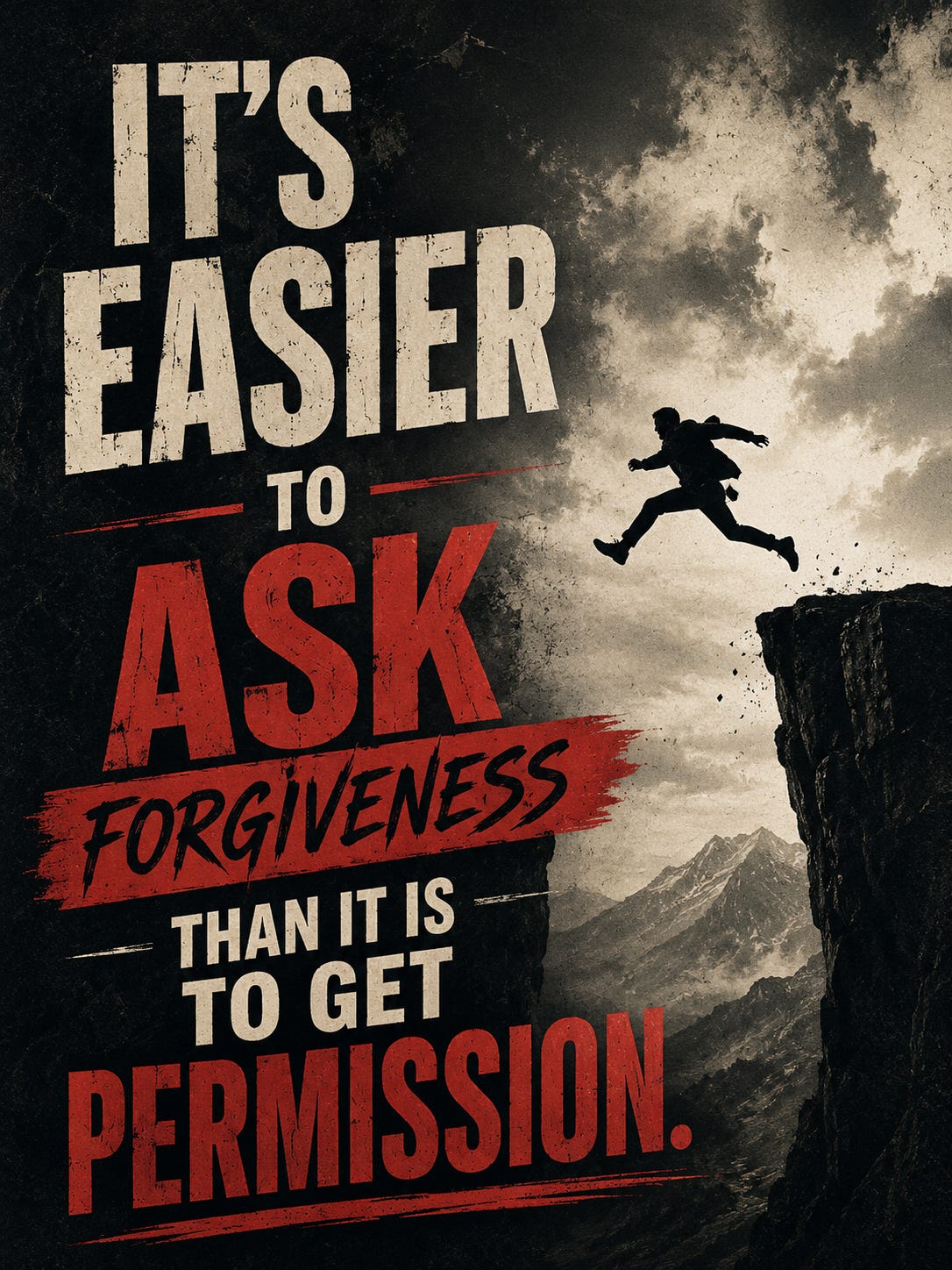
6)
7) The merit of an idea and the charisma of the people pushing it are often completely unrelated concepts.
8) Human beings tend to do a lot of harmful, short-term things to feel good right now, release pressure right now, and take care of a problem right now -- rather than deal with the underlying issue, which would take much longer.
9) There’s no need to take revenge on mediocre people. Their mediocrity is their own punishment.
10) Assuming you can reason it out with someone assumes they’re 1) sane, 2) well-meaning, and 3) see the world like you. Those are not always safe assumptions
11) A lot of times, you’ll get exactly what you put up with, no more and no less.
12) The people pointing out the problem aren’t the problem. The problem is the problem.
13) Gratitude is the shortest-lived human emotion. It’s nice when you get it, but if you let yourself expect it, most people will disappoint you.
14) Paradoxically, the people who don’t feel bad about getting charity don’t deserve charity, while the people who are embarrassed by taking charity are the ones who deserve charity
15) Relationships with other human beings are not supposed to be “even-steven” all the time, but if you rarely ever get more than you give, it’s probably a bad relationship for you.
16) Refuse to get upset over situations you can’t control because in that situation, getting upset accomplishes nothing.
17) Online-only relationships are deeply inferior to real-world relationships
18) Don’t look down on anybody for what they do for a living as long as it’s an honest, honorable job.
19) Nobody wants to hear you complain.
20) Be a good host.
21) Habitually uplift people.
22) Don’t get overly upset about innocent mistakes. Mistakes are part of the process.
23) How someone treats people that can’t do anything for them or that they’re never going to see again tells you a lot about their character.
24) If someone is making money on it, you can’t ever 100% trust what they’re saying about it.
25) Try to be excellent at whatever you do for another human being and ideally, do a little more than expected.
26) High self-esteem coupled with mediocrity is actually considerably worse than low self-esteem.
27) If you’re dating a woman, no matter what you do, expect a little crying.
28) “Change her mood, not her mind” often tends to be really good advice when dealing with women.
29) Your friends’ wives, adult daughters, girlfriends, and ex-girlfriends are plutonium. It’s hands-off and keep a respectful distance.
30) You can get pretty decent at just about anything you practice a lot. Not world-class, but pretty decent.
31) When human beings become miserable, they also tend to become self-absorbed with their own pain, and as a result, they also tend to become thoughtless and selfish.
32) Once you start catering to people’s mental illness and pathologies, it seldom ends well or at a reasonable point.
33) Mind your own business unless you’re given an extremely good reason not to do so.
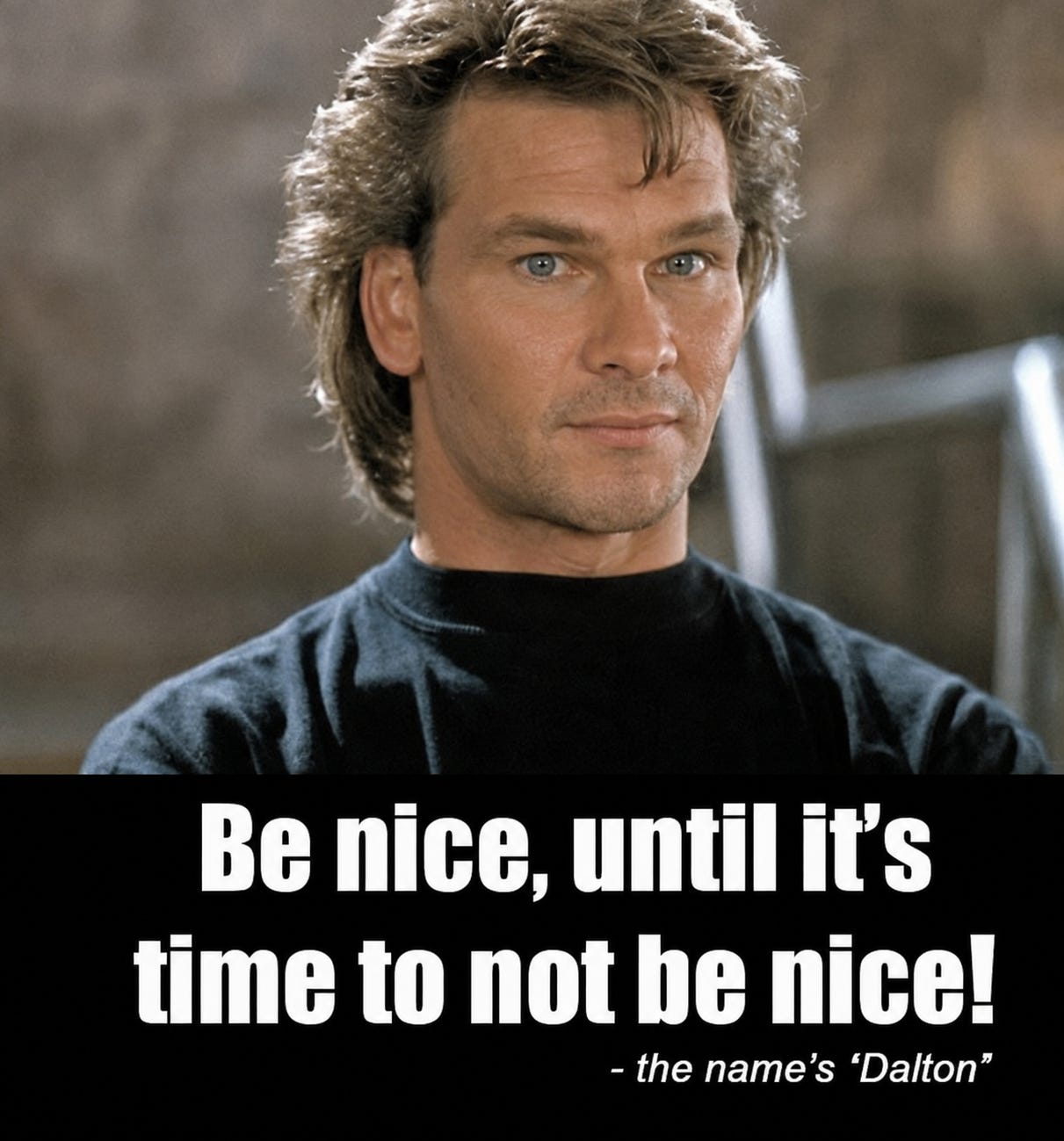
34)
35) People move toward energy, enthusiasm, and people who make them feel good about themselves.
36) How human beings view themselves, for good or ill, is mostly arbitrary and often doesn’t have much to do with objective reality. This can cripple you. Use this to improve yourself, or exploit it if you wish.
37) In the real world, hard work and preparation beat heart, pluck, and the “power of friendship” 99 times out of 100.
38) Tactically ignoring dumb comments, obnoxious people, and lesser males trying to show you up produces better outcomes than confronting them unless they give you no other choice.
39) Maybe people shouldn’t judge a book by its cover, but until they read it, that’s the only way they have to judge it -- and they do.
40) Don’t envy people that succeed; copy people that succeed.
Hawkins: You and I share a love for aphorisms. I enjoyed these. I want to comment on several of them and then share two, one from my grandmother and one from my father.
Here goes:
13) Gratitude is the shortest-lived human emotion. It’s nice when you get it, but if you let yourself expect it, most people will disappoint you.
The French have a proverb: “Do someone a small favor and you may get a friend for life. Do someone a great favor and you’ll make an enemy for life.”
The 2nd part seems strange and improbable but it’s right on target. The reason is that gratitude is an unpleasant emotion for the person who is under the burden of a duty of gratitude. Therefore, heavy gratitude tends to mutate into resentment as that person seeks a way to escape the burden of gratitude and find a way to justify disliking you.
Old people in my family (I grew up surrounded by old people, some of them very, very old) used to tell me when I was a child, “If you are looking for gratitude, look it up in the dictionary. You’ll find it there.”
16) Refuse to get upset over situations you can’t control because in that situation, getting upset accomplishes nothing.
I recommend that people read the Greek Stoic philosopher Epictetus, my favorite philosopher. Epictetus’ point, repeated over and over again, was that the first thing one should do is to separate matters into 2 categories: (1) matters over which one has no control and (2) matters over which one does have control. Then start work on the ones over which you have control and don’t stress out over the ones over which one has no control.
This is wise advice for anyone but especially for “far right”, “fascist”, “right-wing extremists” like us, i.e. people who know that the country is going in the wrong direction and are tempted to fixate on this and poison our lives.
Give Epictetus a read.
18) Don’t look down on anybody for what they do for a living as long as it’s an honest, honorable job.
This brings back an embarrassing memory of an event in my life which shamed me then and still shames me.
I got into a fight with a kid named “Nicky” in 3rd grade.
My teacher gave me a note to take home to my father for him to sign and return to her.
My father was an admirable but rather frightening person. He was brilliant, not only academically (he was valedictorian of his college and #1 in his Presbyterian seminary where he was the top student in Latin, Greek and Hebrew) but in practical matters too.
And he had what Kipling refers to in his famous poem If:
“If you can walk with kings and never lose the common touch.”
Father could do that. He could meet Senator Richard Russell (whose brother had been father’s roommate in college) for lunch at the Piedmont Driving Club (the summit of upper class people in Georgia) and drive from there to a construction site where the Presbytery was building a new church and chat up the guys running the cement mixer and have them eating out of his hand. (I try but I can’t really pull this off.)
On the negative side – father, like my mother, was a very old-fashioned guy, a hard Presbyterian, who psychologically lived at least in the 1800s and probably in the 1700s. He did many good things for me as he raised me but he was way too harsh and demanding. There was nothing touchy-feely about father. He was always my father and not my pal.
So, I walked home, fearing and dreading what would happen, when father read my teacher’s note.
And then, there came into my mind a solution…a “solution” of which I am ashamed even today.
Father had a reasonably impressive genealogy. Among other things, he was the descendant of a general in the Revolution and a delegate to the Constitutional Convention.
Father was not a genealogy snob and always poohpoohed the idea that one could live off one’s ancestors. But I had aunts and great aunts who were genealogy snobs and had heard them bragging about our ancestors.
So, I hit upon what to say to father to avert his wrath.
I walked into the living room where he was reading the newspaper and gave him the note.
He read it, frowned, looked up and said, “Okay, tell me about the fight.”
I told him that Nicky was “not like us.” His father was a “ditch digger…”
The last “r’ in “ditch digger” had hardly escaped my lips when I felt father’s hands grab the lapels of my coat.
“You little twit! I don’t really care about the fight but if I ever again hear you sneer at someone because of the kind of work he does, it will be a day you will never forget and it won’t be a pleasant memory for you. We have pipes and water because people did ditches. They and all other people who do honorable work are entitled to respect…”
I immediately knew that father was right and was deeply ashamed.
I never again made another snotty remark like that again. Every time I hear someone putting someone down along these lines this memory pops up in my mind.
24) If someone is making money on it, you can’t ever 100% trust what they’re saying about it.
Exactly so! I warn young people that they will never talk to a real estate agent who will tell them that now is not the time to buy real estate and they will never talk to a stock broker who will tell them that now is not the time to buy stock.
26) High self-esteem coupled with mediocrity is actually considerably worse than low self-esteem.
I have a leftwing woke liberal relative. He blames criminality on low self-esteem. He will not tolerate anyone contradicting him by telling him that criminals in the jails have the highest level of self-esteem.
39) Maybe people shouldn’t judge a book by its cover, but until they read it, that’s the only way they have to judge it -- and they do.
This proverb “Don’t judge a book by its cover” is completely wrong. Of course, it is meant to say not to judge a person by how he looks, grooms himself, dresses, etc. The proverb is stupid advice. You immediately know a lot about someone at first glance. I have a theory, also, that one’s subconscious reads another person’s subconscious at first meeting. One’s subconscious then evaluates that person and communicates the evaluation to you. Life has taught me that my instincts – especially about people – are almost always right.
The Dutch have a much better proverb that says the opposite thing as what “Don’t judge a book by its cover.”
Youngsters who live by the Dutch proverb will find it helpful.
“A well-cut coat is a good letter of introduction.”
End of comments on your 40 maxims.
Now, Hawkins, here are 2 suggestions of my own (someday I’m going to write my own book of life advice):
Grandmother warned:
“As we get older, we tend to become more of what we are. Our personality traits become stronger and stronger. This generally doesn’t work out well. Thrift becomes miserliness. Generosity becomes improvidence. Even things that were virtues become bad as they become more and more extreme as we age. Naturally, bad traits become more and more offensive and intolerable as they get stronger. Take care to watch yourself as you age and curb this tendency.”
Man! Has that ever proved to be the case!
Father advised:
“Always take mental note of what a person jokes about. Jokes are almost always serious. They are unintended windows into what someone really has on his mind, what he really thinks. People make jokes about things because they really thing that way but they can’t say it straight. So, they release the tension by joking about them. You will spare yourself a lot of trouble in life by taking note of people’s jokes. Laugh at the jokes but note them down!
This also has proven true in my lifetime and I have avoided a lot of trouble by scoping people out by their jokes, jokes that later experience proved to have been self-revelations.
I learned later on that the English have a proverb for this:
“There is truth in mirth.”
P.S. Someone asked me if my comments on your substack messages showed that I dislike you. I don’t know how he got that idea. Maybe I didn’t express myself where.
Please understand that my comments are not a manifestation of dislike.
I don’t know you but I suspect that if I did know you, I would like you.
And I certainly enjoy what you have to say.
Curious, JOHN. Was it you who did a weekly call in to Jaz McKay on KNZR,
back when?