

Let’s say a couple of old billionaires walked up to you after making a Trading Places-style bet about you with each other:
They would freely offer you a billion dollars to spend on anything you want. Mansions, fancy cars, and vacations. Heck, if you wanted, they’d be fine with you using it on alcohol, drugs, and prostitutes. You could have that money and do anything in the world that you want with it, but there would be one condition.
You couldn’t have anyone you really cared about in your life anymore or use that money to benefit anyone close to you. Any good friends and family, you’d have to cut off and never speak to them again. You could never marry. You could never have kids. You could party, mingle, play video games, go to concerts, and sleep around to your heart’s content, but you could never form deeper relationships with any of these people, or you’d lose all the money and the money you made off of it.
In other words, life really could be one long party with you essentially having the money to do ANYTHING YOU WANT, but at the end of it, you go home alone.
Assume those conditions are ironclad and there’s no way to wiggle out of them. What would you do?
It may not seem like it at first, but if you understand human beings, there is a right answer to this question.
In actuality, what we’re describing here, an endless life of hedonism, is a form of hell. Granted, it’s probably one of the more pleasant forms of hell and would probably even be enjoyable for a few weeks or months, but still, it would be hell. Why? Because it would be empty and meaningless. This may not be the message our culture, which endlessly touts money, status, and fame, gives to people, but what Tim Ferriss said is actually true:
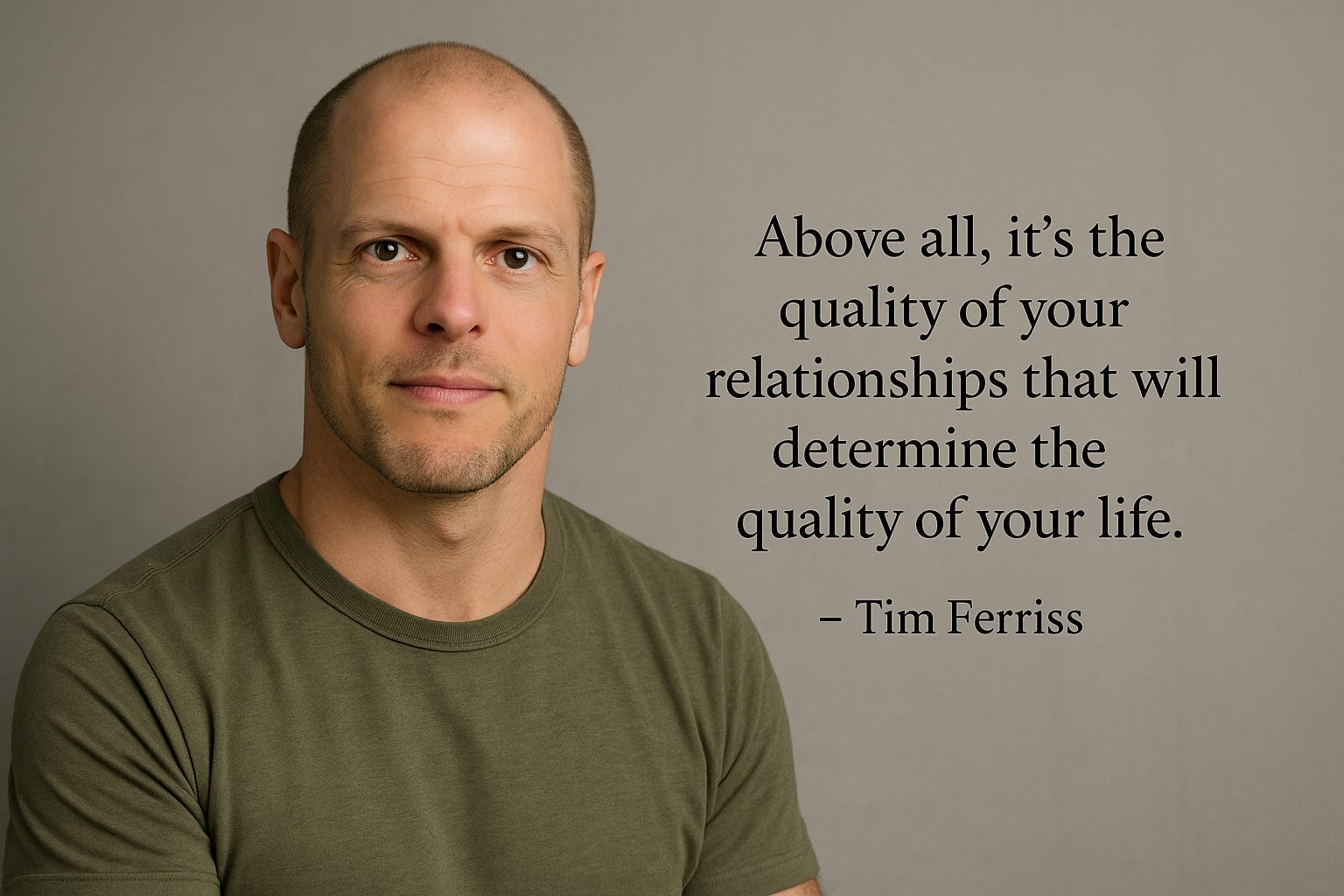
That isn’t the same thing as saying, “Money won’t buy you happiness,” but those two messages do dovetail very well with each other.
And of course, “money won’t buy you happiness” isn’t quite 100% true either, is it?
While there is still a dispute about HOW MUCH money people need to be happy, there are numerous studies that clearly show people do get happier based on the amount of money they have, at least up to a certain point:
Studies suggest that beyond a certain income threshold—often cited around $75,000 to $100,000 annually—the additional happiness gains from extra income begin to level off. A boost in salary can make a big difference if you are struggling with basic needs. But you’re less likely to notice the extra income if you are already comfortable or doing well.
Of course, when people think about the phrase, “money won’t buy happiness,” they’re typically thinking of people with truly vast amounts of money. We’re talking about Bill Gates, Oprah Winfrey, and George Soros levels of capital.
Why would people flatline on how much happiness they get from money long before they get to that level?
There are reasons for it.
That takes me back to when I didn’t have that much money, and someone at a business event invited me to a ritzy steak place. It was VERY expensive. A steak there was something like $80, and that’s before the sides and drink. At the time, I did not have $80 to throw away on a steak, but I was curious about what one of those steaks would taste like. The person who invited me was like, “Hey, I’m going to cover this, so just get whatever you want.”
So, I got the super expensive steak, and it was good. But was it amazing? Was it incredible? Was it life-changing?
No.
In fact, I would say it was roughly comparable to getting an $18 piece of meat, salt and peppering the hell out of it, then slapping it on the Foreman grill for 7 minutes. If I were being charitable, I might say that it was marginally better, but that’s it. Since then, as I’ve made a little more money, I’ve gotten to eat more expensive steaks from places that specialize in them, and every time, I come to the same conclusion.
Basically, “This is good, but arguably not much better than what I could eat at home for a quarter of the price.”
This is just the way of the world with most things.
You get a big improvement from the cheapest goods to the medium-priced goods.
Then, there is a significant, but smaller improvement from the medium-priced goods to the expensive goods.
Last but not least, you get an even smaller improvement from the expensive goods to the extraordinarily expensive goods.
So, moving from a Chevrolet Chevette that breaks down every couple of months to a Toyota Camry that never breaks down may legitimately improve your life, but moving from the Camry to a Beamer or even from a Camry to a Lambo probably would make a lot less of an impact than you’d expect.
In other words, up to a certain point, making more money is pretty much all upside. If you can’t buy what you want at the grocery store, pay for it if your car breaks down, or get new sneakers for your kid, it creates stress in your life. However, once you get to a certain level, that stress goes away and everything smooths out.
What that means is that more money may provide a bigger house, a nicer car, or a fancier vacation spot, but those things are just nice to have and don’t necessarily move the happiness needle very far.
In fact, once you get to a certain point, having truly massive amounts of money starts to come with significant downsides as well. A mansion means full-time staff to manage, huge tax bills, and more things that can break. Being filthy rich means more people who only talk to you for your money, or who are constantly hitting you up for cash.
In fact, if you really do get to those Bill Gates, Oprah Winfrey, and George Soros levels of wealth, you’re going to need full-time bodyguards to make sure someone doesn’t lock you in their basement and torture you with pliers until you transfer millions of dollars to them.
Does that mean that if you had the opportunity to become that wealthy, you should turn it down? Not at all, but what it does mean is that you shouldn’t expect it to fix all your problems or, even more importantly, make you happy. Money really can’t buy your happiness, and once you get enough of it to take the day-to-day financial pressure off of you and get a few extras that excite you, it’s probably going to do a lot less to increase the quality of your life than you would expect.
My late dad always said, money can't buy happiness, but it let's you choose your own
form of misery.
In today's society people are more concerned about telling others that they have/had the luxury item than any true satisfaction they get from the item. Totally agree with the steak & Camry examples and would add that most satisfaction from the 'BMW' is short term then you move on to something else.