

In Denmark (and in all fairness, some other Scandinavian countries), mothers sometimes leave their babies outside in carriages while they go inside to shop:
In Japan, they have completely unmanned stores full of cool stuff that are open all night long:
As an experiment, this guy left his laptop unattended in a coffee shop for an hour in Singapore, and UNSURPRISINGLY, it was still there when he returned:
In the Netherlands, you may see thousands of sometimes very expensive bikes, unattended and unsecured:
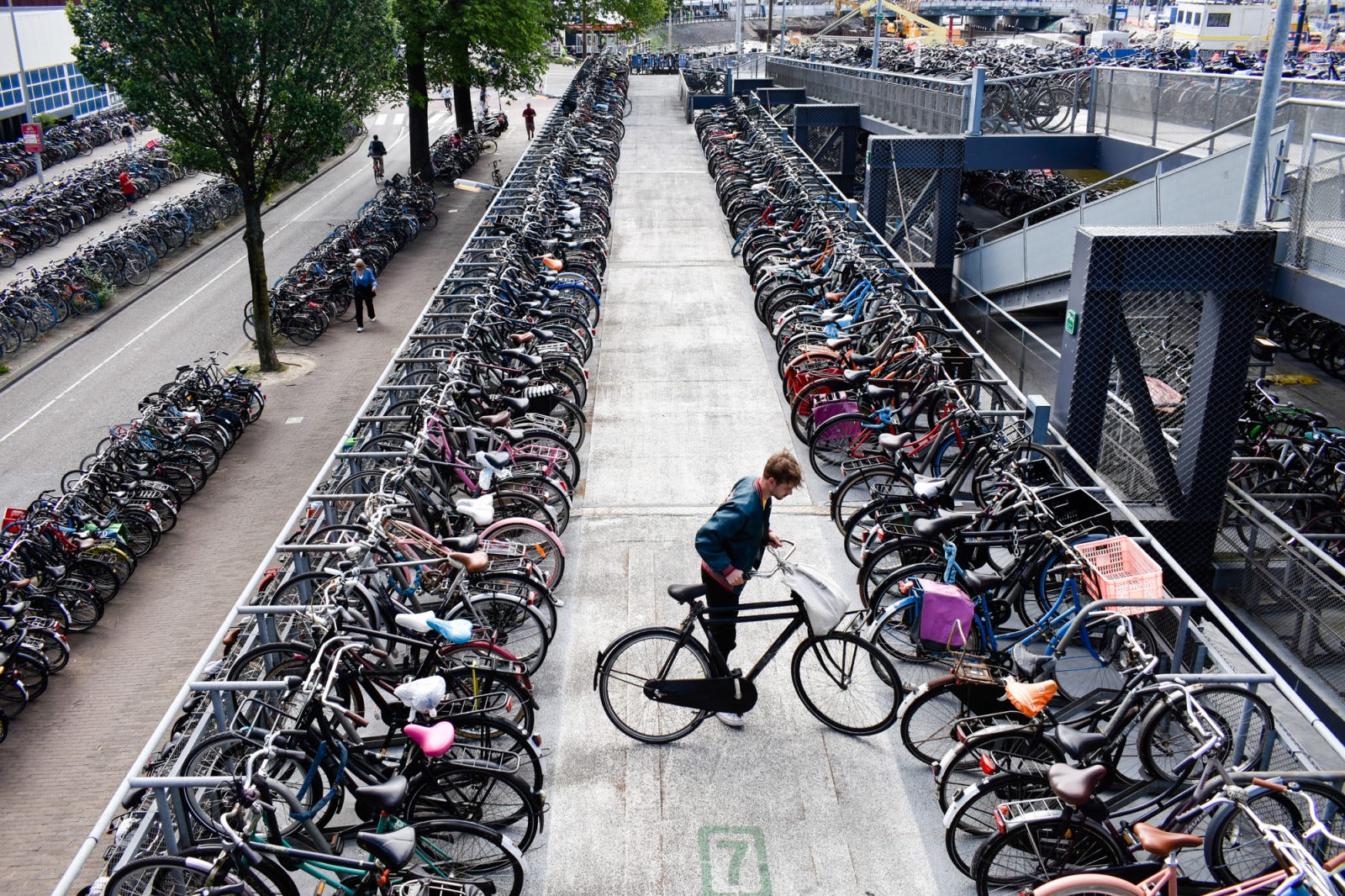
This begs two obvious questions.
The first is. “How is this possible?” and the second is, “How can we have that here?”
The answer to the first question isn’t as clear-cut as you might think, although success leaves clues.
There’s no universal agreement on what makes for a “high-trust society,” but the general consensus would probably revolve around it being honest, safe, low-crime, low-corruption, and a general belief by the people there that most people can be trusted. If we were coming up with a list of countries that generally fit that definition, it would probably include these nations:
· Denmark
· Finland
· Iceland
· Japan
· Netherlands
· Norway
· Qatar
· Singapore
· Sweden
· Switzerland
· United Arab Emirates
You’ll note that these countries are not uniform. There are a number of white, mostly protestant Scandinavian countries, Asian nations, and Islamic countries. Not all of them are democracies either.
That being said, these countries are mostly ethnically homogenous (Singapore and Switzerland could arguably be exceptions depending on how you look at it).
Crime is harshly punished in some nations, particularly the Arabic ones, but not so much in the Scandinavian countries, although they would argue that even if they don’t hand out draconian punishments, they’re very good at tracking down criminals, so the likelihood of being caught after committing a crime is high.
What you would see in all these countries across the board is a lot of pressure to conform, effective governments, and a lot of social/civic cooperation.
Now, we get to the second question: How can we have that in America?
There is no simple answer, because there is no one template for a high-trust society, but remember what I said about success leaving clues?
Well, there are many Americans who are alive today who were also around when America actually was a high-trust society.
What differences are there between then and today?
Well, many people may not like hearing this, but we were a much less diverse society, which is something you see in almost all of the current high-trust societies. The 1965 Immigration and Nationality Act has been a disaster for America on a lot of fronts, including this one.
It’s also no coincidence that America was much more devoutly Christian then:

People who listen to sermons about morality every week at church and see their neighbors there are a lot more likely to be trustworthy members of the community than people who don’t.
Back then, Americans were also much less tolerant of what they viewed as bad or immoral behavior. If you ran your mouth to a cop, you could expect to get a beating. If you had a child out of wedlock or got divorced, you were considered a bit scandalous. Kids were expected not to talk back to adults, you didn’t typically see married couples sleeping together on TV, and there was genuine moral concern about things like Elvis shaking his hips on TV.
There was also a lot more sense of community back then. People saw each other at church, at dances, at the Elk’s club, Rotary clubs, on bowling night – in a whole host of places that a large portion of the population has since abandoned.
It’s very easy to spew venom anonymously at someone you’ll never see online, but when you’re seeing people in person regularly, and you might need to borrow their lawnmower or want to get an invite to their barbecue next week, you tend to be a lot more polite.
The country was also more patriotic and more concerned with the good of the community back then. After fighting two World Wars and being involved in a Cold War with the Soviets, Americans understood that we were all in it together, and how well our country functioned mattered a great deal not just to us, but to the free world.
Today, our society is much more individualistic, often in a deeply unhealthy way, where many people simply don’t care about the impact of the things they do on other Americans. Our sick influencer-centered culture that often rewards terrible behavior with attention and money is only making things worse on that front.
So, how do we get back to that high trust society? Back to a culture where you can leave your doors unlocked, people treat each other with respect, and everything isn’t just so TOXIC?
There’s no perfect roadmap, but we can make some educated guesses.
We need…
* …more Americans to start going back to church.
* …to be orders of magnitude less tolerant of anti-social, disgusting, and selfish behavior across our society and much more willing to shame people who deserve it.
* …to insist on competence from our government and institutions without giving them a pass for being on “our side” (And that goes for all sides).
* …to create on a merit-based immigration system, refuse to allow immigrants to collect welfare, denaturalize immigrants who engage in crime, and harshly treat people who enter or stay in our country illegally.
* …to find ways to get together more in the real world with our friends and neighbors.
* …to become much more concerned with making everyone live up to the same standards and much less interested in looking for exceptions to the rules.
* …to hold people accountable in the real world for their bad behavior online.
* …to get better at tracking down criminals and punish them more harshly.
* …to become less self-centered, more patriotic, and concerned with what’s good for people around us.
Can America do these things? Of course, we can. In fact, we HAVE DONE THESE MOST OF THESE THINGS, and our society generally functioned much, much better when we did. On the other hand, there is a huge difference between theoretically doing something and trying to get people in an increasingly decadent and self-centered society to adopt practices because they’re good for everyone else.
All I can tell you is that if you want a country where you can trust the media, don’t have to worry about your child playing in the yard, and can walk down a dark alley in a big city without worrying about your safety, you can have it, but it won’t happen by magic. We could continue on for a million years, but we’d never get to a high-trust society behaving the way we do today. It’s going to require different choices and changing the way we do things to get there. Would it be worth it? Absolutely, but a large part of our population has to feel that way to make it happen.
You are exactly right, of course. I would add the following:
1) the stupid war on poverty destroyed the black family structure (the divorced rate among black families was lower than whites until the 60’s). This has resulted in generations of untold young men being raised without fathers.
2) insanely believing that diversity in immigration would be better for America.
3) Hollywood glorifying deviant behavior.
4) The destruction of our education system which no longer teaches basic values and pushes an anti-American (trashing values of personal responsibility and golden rule).
Anyone who thought about this ahead of time had to know the outcome. Did this just happen by happenstance? Perhaps, but the likelihood is far greater that the destruction of America’s traditional values was the intended goal.
Exactly. It is stupid for anyone to debate it. If you an American owning traditional American values has an Indian immigrant family move into their home. Is each family going to trust the other? The Indian family does not own the home... does not feel ownership of the home... has a home back in their home country that they remember and love. They also have different cultural beliefs and their behavior is unexpected. Compared to other American family members moving in, there would be a significant deficit in trust between the people of the two families.
Cultural homogeneity, shared cultural values, is the key to a high trust society.
The point about law enforcement I think is secondary as there are countries like North Korea that have some of the strictest law enforcement and yet trust is probably one of the lowest of any country. Instead of strict law enforcement, I think it is more a realized expectation that institutions are going to perform rationally and in predictable ways. And that gets back to shared culture.