

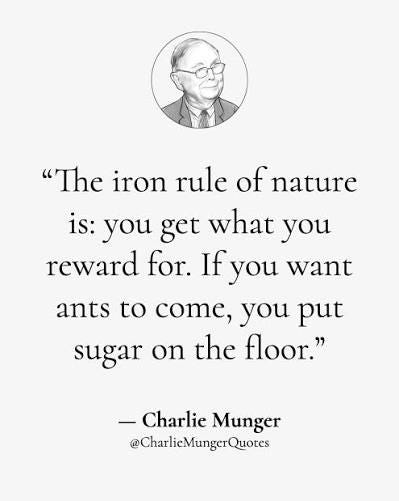
If we could ask men and women from all different periods of human history what the point of getting married was, many of us might be surprised at how different their answers would be from the ones we’d give today.
We might hear things like:
* “My family needs the dowry.”
* “How else am I going to get sex?”
* “Marrying a man is the only way to support myself and my children.”
* “Taking care of a household is a full-time job, and I can’t do it alone.”
* “I have to get married to produce legitimate heirs.”
* “It’s wrong to have sex outside of marriage.”
* “If I had a child outside of marriage, they’d be a bastard, and I wouldn’t want the stigma for my child or me.”
* “We need to join our families together.”
* “There’s something wrong with people that don’t get married.”
* “Having children inside of marriage is the only way to continue the family name.”
* “A man and a woman working together and producing children to help the family have a better chance of survival than one person alone.”
In other words, marriage, which predates Christianity by thousands of years, was not invented by the Bible or just something people did for the heck of it. It has always had a PURPOSE and reason for existing.
That’s still true today… to an extent.
Marriage unquestionably benefits our society. Additionally, statistics clearly and consistently show that marriage is the best way to raise a child and that married couples are happier than single people (although it’s worth noting that single people tend to be happier than divorced people).
That being said, marriages are made up of people deciding that getting married is in their best interest. If people don’t believe that marriage benefits them, they won’t get married.
I was thinking about that when I read this post on X:
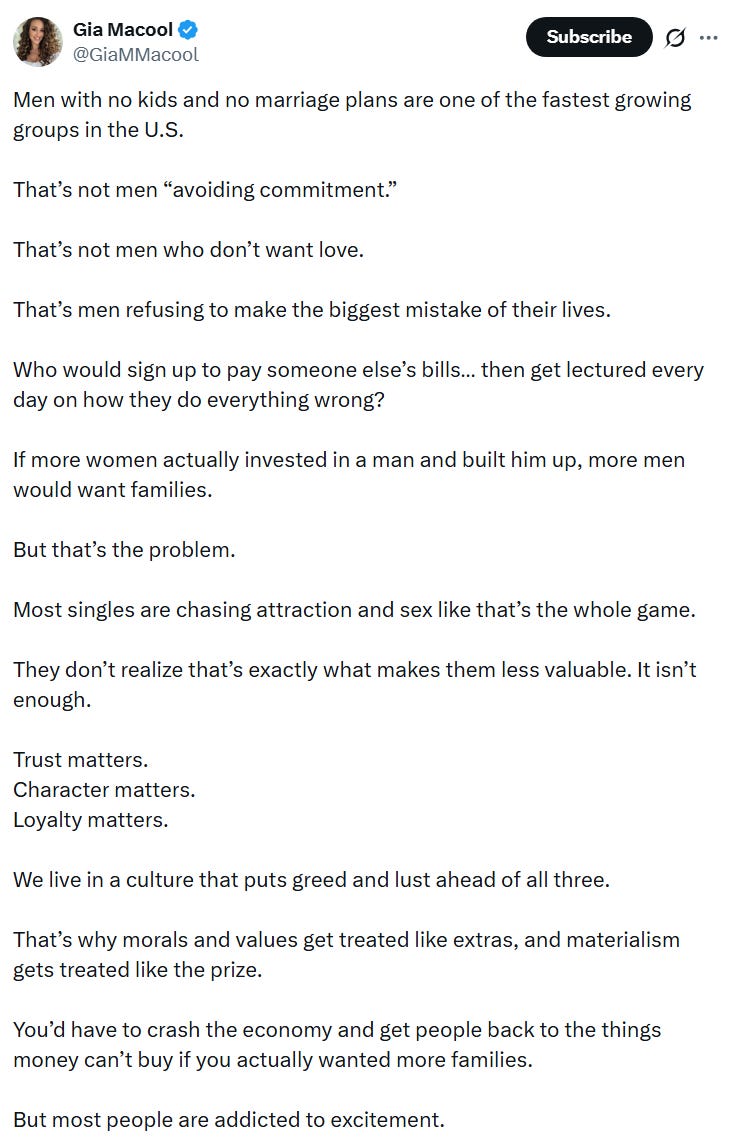
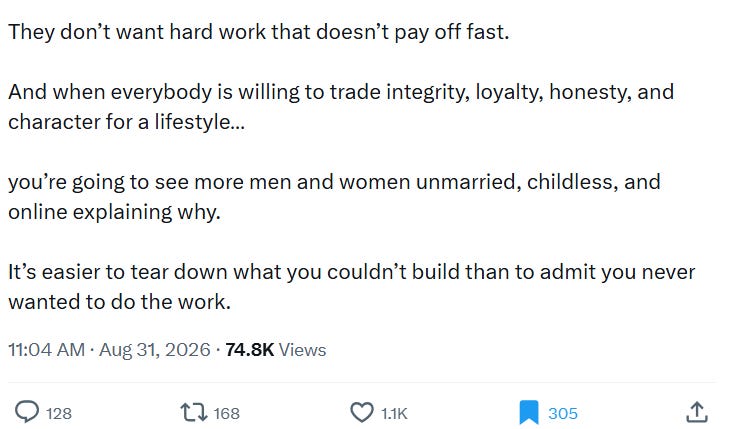
Some people like to point a finger at men or women for the breakdown in relationships in modern America, but it makes more sense to think about the incentives. How does the man benefit from getting married? What about the woman? What does it cost them?
It’s also worth asking what the benefits and drawbacks of marriage are compared to what they used to be.
If you’re male, do you still need to get married to have sex? Not at all. If you’re a man not really looking for marriage, are you locked out of dating or relationships? No. Is it still thought of as “weird” or “gay” not to get married? Maybe a little, but not so much these days.
Do you have to be married to have a kid? No, the world is full of single adults with kids. Are the cleaning, cooking, and maintenance duties required to run a household so difficult that you really need someone to handle it for you, so you have time to work? In the age of washing machines, microwaves, and Roombas? Not in the least. Housework is now a minor annoyance, not a full-time job.
Are marriages used to cement family alliances anymore? Nope. Is your wife going to treat you like the “king of the castle,” have amazing home-cooked meals ready for you when you get home, and value all the hard work you put in at your job to pay for everything like women did a century ago? It’s unlikely.
Marriage is not even viewed by most people as a lifetime commitment anymore. For way too many people, it seems to be more like a commitment to stay with someone until you get bored, hit a rough patch or just want a change. That means divorce has also become much more frequent and divorce court is heavily rigged against men.
What all this means is not that marriage is bad, but that the incentive to get married has been heavily eroded – and not just for guys.
Are women still going to be stigmatized as hopeless sluts if they have sex outside of marriage or get pregnant outside of marriage? Not unless they go to ludicrous extremes:
Women have been told that they need to have a career, and being a stay-at-home trad wifie is dangerous because what if it doesn’t work out? You’re going to be 35 with no skills, and then what?
Of course, the flip side of that today is that most women don’t “need a man” to support themselves. They’re more likely to get a college degree than a man, and they can get a job and spend all their money on themselves if they want.
But what if they get pregnant and there’s no man around? The government will force the man to pay child support or assume the role a husband once would have by supporting her.
Does a woman have to be married to be socially respectable? No. Are many women that do get married even FINANCIALLY INCENTIVIZED to get divorced by the possibility of getting half of what their husband earned and exorbitant child support payments while they’re not required to give anything to their husbands in return? Absolutely.
Many women also consider it important to “marry up,” but with more women than men getting degrees and more women than ever working, it makes marrying up harder than ever for women.
So, if a woman doesn’t need to get married to have sex, support herself, or her kids, what does she “need” marriage for? There are answers, but there are many, many fewer of them than there used to be.
Now consider factors that affect both sexes. There are more entertaining things to do and spend your money on today than ever before in human history. You don’t “need” a husband or wife to fill your time or share all of that with.
Furthermore, dating apps have gained a well-deserved reputation as a hellscape in recent years, but they at least give you THE ILLUSION that there are large numbers of potential partners ready to go the second you want to pop on and “swipe right.”
Our society has also degraded and weakened many of the institutions where people went to meet, get to know each other, and form relationships. People today are much less likely to meet someone at church, a social club, or around the neighborhood and are much more likely to rely on dating apps. Even if you do want a “permanent relationship,” living together is more acceptable today than ever before. If you want to say, “That’s not permanent because either person can just decide to leave any time they want,” it’s fair to note that you can now say the same thing about marriage.
Perhaps most importantly, we also can’t forget that couples used to get married much, much earlier than they do today. If you’re both getting married at 20, you’re basically starting your adult lives together. If you’re both getting married at 30, you started your lives separately, and getting married will be a huge change from how your life has been going up to that point.
None of this is meant to be anti-marriage because again, marriage is good for society, and it also seems to be good for couples that stay together long-term.
However, it’s still important to think about marriage in terms of incentives, because if you don’t, it makes fixing a declining, broken system very difficult.
How do we get people marrying earlier? How do we make it more beneficial to both men and women to get married? How do we make it less appealing to stay single and either dramatically lessen the number of people getting divorced or make it less traumatic to get divorced?
There are many answers to those questions, but they have to be ones the American public will accept and embrace. Until that discussion gets opened up and we start considering some changes to the way we do things, marriage in America is likely to continue to decline.
Alas, the curse of social media is that the grass is always greener on the other side ,so many men and women believe that they can do far better than the options before them. Then, after waiting and waiting for but finding the “super model” or “perfect man” they were promised, they’re angry and jaded, and now, no one will have them.