

Lauren Southern is not someone whose work or life I’ve ever followed closely. As far as I knew, she was an attractive, blonde alt-right personality that briefly got some attention and then disappeared. However, when I saw that she had a tell-all book out called This Is Not Real Life, I definitely wanted to read it. Politics is a sleazy business, and as someone who’s in it, it’s interesting to get more details about what’s going on in the dark corners.
Again, since I know very little about Lauren Southern, my opinions of her were formed by reading the book. On the one hand, she’s obviously intelligent, very insightful, and a great storyteller. On the other hand, by her own account, she spent almost every moment of the last few years either high, in the middle of a mental breakdown, making obviously terrible decisions, or questioning everything she believes in. So, it’s a little difficult to know how reliable a narrator she is in every situation. Still, she did drop some interesting nuggets in the book that tell you a lot about what is fake and compromised that you’re seeing online.
Later in her career, Southern worked for Tenet Media, which turned out to be a Russian front operation with millions to spend. This is from a PBS article about it:
Tenet’s website lists six influencers who provide content, including (Tim) Pool, (Benny) Johnson, (Dave) Rubin, Lauren Southern, Tayler Hansen and Matt Christiansen.
…The indictment shows that some of the influencers were paid handsomely for their work. One unidentified influencer’s contract included a $400,000 monthly fee, a $100,000 signing bonus and an additional performance bonus.
Intriguingly, according to Southern, they really didn’t push the influencers to take any particular line. Of course, that may have been coming later (more on that in just a moment):
Humans have figured out you can profit by manipulating people. Every nation is doing it: Russia, China, Qatar, Saudi Arabia, the UAE, Iran, India, Israel, even the United States. Every one of them is paying influencers for endorsements and PR trips. I had seen it firsthand. In fact, Tenet may be the dumbest example of foreign interference, given the total freedom and discretion hosts were given in their publications.
Some of this I can tell you about personally. Many years ago, I had a think tank that I was doing a little work for that floated the idea of a trip to Israel that I assumed would have been paid for by the Israeli government. It would have basically been a VIP tour. Seeing all the cool sites, meeting government officials, etc. I didn’t see any problem with doing it as long as I would have been able to reveal to people that the Israeli government funded it when I wrote about it.
On the other hand, I have also been approached about writing articles for pay more than once. In fact, I was told that with my social media following and audience on Culturcidal, I could potentially get as much as $3,000 per article I wrote. Given that I am not one of the bigger fish in the conservative media ocean, imagine the amounts that are being thrown at other people. In my case, I certainly considered trying to collect all that sweet, sweet cash, but one of the conditions would have been that I didn’t reveal I was paid to write the article. Could there be situations where that was ethical? For example, what if you were paid to write an article pushing something you already believe? I decided against it, but arguably, “yes.” The thing is that once you go down that path, you are almost certainly going to be compromised down the road because outside companies and nations want you to push their interests, not yours and those interests often do not coincide.
If we’re talking about, say, retweeting someone on X for pay or an Instagram influencer showing off some makeup or a bag they were given for free or paid to promote, the lines become more blurred, although it’s generally considered ethical to do that. I wouldn’t think worse of someone that did either of those (although some people would) and the amounts we’re talking about here to do it can be staggering:
Among the highest valued, non-transparent shills is Lindsay Lohan, who allegedly charges $20,000 for a single tweet and $35,000 for the tweet and retweet package deal.
The marketing company also offers a “high budget” deal for companies with the deepest pockets. For a fee of $130,000, 114 Twitter influencers with a combined follower count over 19 million will each publish two promotional tweets and one retweet.
...Comedian Che Durena allegedly offers a promotional TikTok post at just $20,000, while an Instagram post from rapper Lil Yachty is a mere $50,000.
Where this gets much sketchier is when we start talking about crypto altcoins. Because then, you’re not just promoting something, you’re encouraging people to put money into what often turns out to be a scam. The money goes in, it gets “rugpulled,” and most of the people who put money in lose everything. The most famous one recently was pushed by the “Hawk Tuah” girl:
Influencer Haliey Welch, who rose to fame as the "Hawk Tuah" girl from a viral TikTok video last year, became the epicenter of a major controversy after launching a dubious cryptocurrency meme coin called $HAWK in December.
The token hit the roof in mere hours, reaching a market cap of almost half a billion dollars, before plummeting back down and leaving investors hanging out to dry. The events cemented it as yet another classic pump-and-dump, a recurring fixture in the largely unregulated crypto world.
Believe it or not, she seems to have escaped prosecution by essentially playing the “I’m just a dumb girl and I didn’t understand how this whole thing worked” card. In any case, this is something you’re starting to see more of among conservative influencers on X, and you should be EXTREMELY suspicious of it. That wasn’t always the case, but today? The chances it’s a straight-up scam are very high.
However, there’s another key factor that Southern touches on that most people overlook. Botnets:
Earlier this year, I did an interview that supposedly got 200,000 views. But I’m convinced almost none of those are real. No buzz, no mentions, no traffic spikes, just a wall of near-identical comments from bot accounts. The channel owner has bought his views and built a fake reputation on it and it was working. I thought it was a legitimate show. He even got a bunch of other commentators to come on – all tricked the same way.
How pervasive is this? EXTREMELY. Here’s a ChatGPT estimate of how many fake users are on each social media platform:
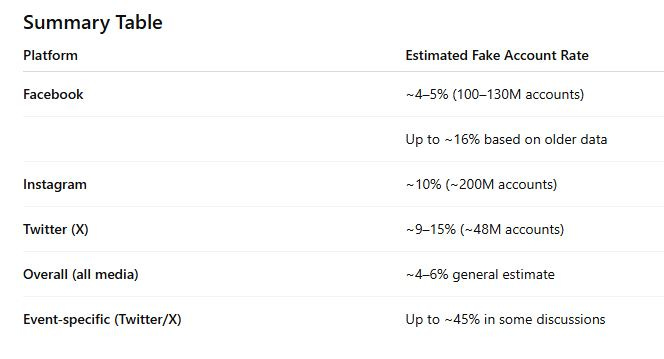
On the one hand, you may look at these numbers and say, “They’re a relatively low percentage of the user base,” which is true. The flip side of that is even if we’re talking small numbers percentage wise, the actual number of accounts involved is ENORMOUS. This enables corporations, politicians, and yes, even foreign governments to manipulate public opinion from behind the scenes.
How? It’s easy.
Step 1: Pay several relatively popular influencers to take a particular position.
Step 2: Have your armies of bots amplify their message, follow them, and promote them at every opportunity.
Step 3: Use your bot armies to trash anybody going against this message and promote any people who happen to echo the opinions of your bought and paid for influencers.
Step 4: Much of the media in America equates popularity and followers online with popularity and followers in the real world. So, next thing you know, the illusion of popularity you created online leads to the opinion you promoted getting real world earned media from large outlets.
At one point, the idea of running a campaign like this would have been to promote something. You know, “Saudi Arabia is America’s friend” or “All the cool people are buying Nikes.” There is still some of that, but the level of sophistication has gone up.
Now, the pros realize it’s easier to push hate and controversial ideas that promote something. There’s no way to prove it, but you can be almost certain there are tens of millions of dollars being spent on X to trash or promote Israel or to encourage Americans to support either Russia or Ukraine. You can also be 100% sure there are also enormous numbers of accounts that are designed to create chaos in the United States, either by encouraging the Left and Right to hate each other, trashing things that would build the country up, or by promoting horrible ideas. Don’t get me wrong; There is no shortage of bad people, bad ideas, and dislike between the Left and Right in America, but there are also massive amounts of money and armies of bots encouraging it along.
Don’t even get me started on the impact of AI on all of this, but it’s going to soon be making everything infinitely worse:

What is the workaround for all of this? it’s hard to know. People love to say, “Do your own research,” but the majority of human beings do not have the base knowledge level or finely honed bullsh*t detector needed to get to the truth on a lot of subjects.
Sure, you could ask AI, but it has its biases as well. Maybe it’s not supposed to, but as someone who uses it a lot, it absolutely does.
Could we say, “No problem, just listen to trusted sources?” Sure, but which trusted sources? If ten of us named our trusted sources, would we agree? Doubtful.
Ultimately, there are no easy answers. We’re all just going to have to muddle through and do the best we can.
Also see: 20 Ways People Get Manipulated by the Media.
On the ethics of taking money to write, I say take it if there are no conditions and it's disclosed. I am literally paying you right now to write. I do it gladly. Nobody has any misunderstanding about it. Writers deserve to be paid.
But even so the ethics are always tricky. You probably have some vague awareness that if you go full Bill Kristol or Jen Rubin all your subscribers are gone. So even if you aren't explicitly shilling, potential "corruption" is always there, even if it is only subtle.
Even if no money is involved, just the loss of followers or standing can keep people from saying the what they see as the truth. As Emmerson said, "as soon as he has once acted or spoken with eclat, he is a committed person, watched by the sympathy or the hatred of hundreds, whose affections must now enter into his account."
That's part of how the botnets influence people, through an elaborate preference falsification. "Everyone thinks the other thing, you are the crazy one".
But anyway. Since the potential is always there, even when not acted on... In the words of Wyatt Earp in Tombstone, "Already have a guilty conscience, might as well have the money too."
I'm going to say take the money, just disclose it. And never, ever say something you don't actually believe. Credibility is everything. That's why they want to buy it so badly. If you lose your credibility as a honest voice, you're a laughing stock.
Look at the aforementioned Jen Rubin or Bill Kristol. The right openly mocks them, but the left doesn't want them either. They're worse than irrelevant, they are pitiable.
It isn't just the Internet. The media in general went from a general information source to an advertising and influencing source. The legacy / corporate media is no longer independent. It is owned and operated by the corporatocracy that is aligned with the establishment administrative state.
Over 50% of the population are afflicted with low capability for emotional regulation. These are people that can be made hysterical, fearful, anxious, etc. It is the natural human condition. The news media used to be a calming influence delivering the pragmatic and factual story. Not only did the news media stop being the calming influence, but it shifted 180 degrees in fomenting hysteria, fear and anxiety... as a call to action for those with low capability to regulate their emotions (mostly female).
The Internet just amplifies what was already happening.
We have met the enemy, and it isn't the Internet, it is the media.