

It’s no surprise that someone who wrote a whole book of advice for young adults would be interested in an article titled, “14 Brutal Truths I Know at 40 and Wish I Knew at 20.” That goes double when we’re talking about an article by Mark Manson, a guy with three New York Times best sellers whose work I very much respect in the self-help space.
With that in mind, here are Mark Manson’s “14 Brutal Truths” that he wishes he knew when he was 20, along with my commentary on them. Hopefully, people, particularly younger Americans, will get something they can use out of this:
1. You don’t need a productivity system; you need a bedtime: These may seem like two unrelated things, but they’re really not because of how most people live their lives.
So many people get engrossed in a game, social media posts, or binge-watching a TV show, then go to bed way too late, get up way too early because they have to be to work on time, and repeat that cycle over and over, sometimes for decades. They’re tired all day long, they want to fall asleep in the afternoon, and they think they need some kind of productivity system to make up for it.
No, you just need to wind down at the end of the day and go to bed on time. Once you start doing that, most of your productivity troubles will get better in a hurry. Trust me, I know this isn’t easy because I have struggled with it myself. However, if you do this, you’ll feel better, you’ll have more energy, you’ll be sharper, and you will get more done.
2. 8 hours of sleep and a daily walk outside will solve as many of your problems as any online guru or coach will: Manson’s main point here is that there are a lot of things that are simple to understand, yet very difficult to do, like breaking up with a girlfriend. So, we human beings feel like there must be some easier way to do it that we can learn. That leads us to start looking for the “11 steps to breaking up with your girlfriend the easy way” explainer, when the actual steps are:
A) Break up with your girlfriend.
B) She gets extremely upset, cries, and you feel really bad about hurting her.
C) Life continues with the two of you apart.
In other words, getting some sleep and getting your mind right so you can do what you need to do in these situations will do more for you than trying to create some fancy system to get around the pain.
3. The most effective antidepressant in the world is exercise: This sounds like some hacky thing you’d hear from an Instagram fitness influencer, but there’s a lot of truth to it:
An expansive analysis of existing research concludes that physical activity should be viewed as a first-choice treatment for people living with mental health issues. The analysis distills the conclusions of nearly 100 meta-reviews of randomized controlled trials. Physical activity is 1.5 times more effective at reducing mild-to-moderate symptoms of depression, psychological stress, and anxiety than medication or cognitive behavior therapy, according to the study’s lead author, Dr. Ben Singh.
Every person’s depression, particularly someone who is clinically depressed, isn’t going to be fixed with exercise, but MOST PEOPLE would probably be better off regularly exercising than going to a therapist or getting on drugs. At a minimum, it’s something worth trying.
4. If you don’t choose your priorities, the world will choose them for you: It’s like Jim Rohn said:
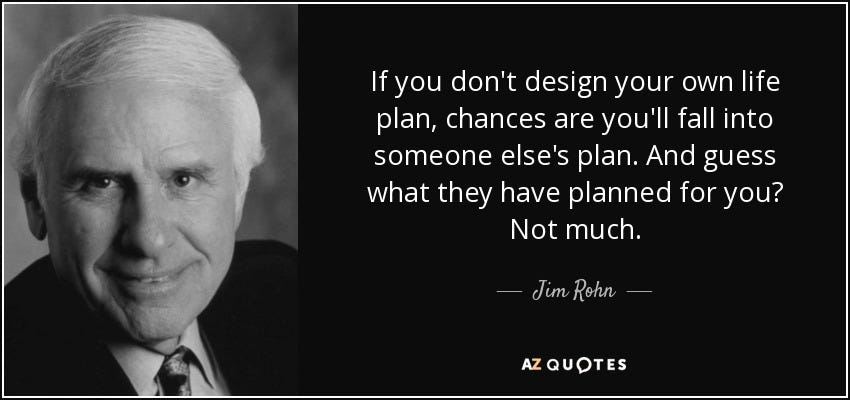
If you don’t think about what you want most in life and go after it, nobody is going to make it happen for you. Everybody has things they want you to do that further THEIR dreams. Buy their products, watch their show, go to their protest, spend hours on their app, give them your money, your time, and your attention. Do they deserve that? Mostly “no,” but if you don’t know what you want and get after it, you will find yourself enmeshed in building other people’s dreams instead of your own by default.
5. What are you willing to experience friction and be disliked for: Until you find the courage to speak up for what you really believe in and pursue what you think is important, you’re never really going to be free. You’re going to spend your whole life doing what other people want you to do and saying what they want to hear.
Everybody wants to be liked. Everybody wants to be popular. Everybody wants to be accepted. But if you have to pretend to be someone or something you’re not to do it, the price is too high.
6. If saying “no” makes you feel guilty, you were trained to neglect yourself: A lot of people quite understandably have a backward way of looking at being a person who serves others. They believe that to do it, they always have to put everyone else before themselves.
This is a recipe for misery, not just for of the obvious reasons, but because, subconsciously, people who do this almost inevitably have unspoken expectations that go along with it. In other words, they want to be perceived as “selfless,” but actually it’s more like, “I will be selfless and in return, I secretly expect you to do X, Y, and Z for me.” Then, when people don’t go along with the secret contract they never knew about in the first place, these people inevitably get angry, frustrated, and feel unappreciated.
Instead, you should focus on making sure your own needs are met first so that you can feel very comfortable meeting other people’s needs with no silent expectations on the line. If you’re satisfied and happy, it’s easy to give, help, and be selfless to people you care about without feeling resentful about it. In other words, you absolutely SHOULD help other people, but the only realistic way to make that work long-term is if you make sure your needs are met first.
7. Most people aren’t actually stuck because their life is too hard; they’re stuck because the distractions feel safer than the solutions: You would be surprised at how many people get some kind of underplayed benefit out of what superficially seems to be destructive behavior. Why? Because subconsciously, they enjoy their bad habits, they get some kind of secondary gains out of it (example: getting attention and kind words when you’re sick), or they’re just reluctant to go down a good, but difficult path.
What’s an easy way to keep from going down a good, but difficult path? Getting distracted. You go on a Netflix binge, go down a rabbit hole on YouTube, or spend all day playing a video game. It’s like punting on the solution to your problems. “Oh, I didn’t get to it today, but tomorrow I will.” Except this can go on for months, years, or even decades if you’re not careful.
8. Learning more is a smart person’s way to procrastinate: I am absolutely guilty of doing this, and so are a lot of other people. Ultimately, life is a lot like that famous Patton quote:

Once you get past a certain level of knowledge, experience in the real world almost always beats a book, a seminar, or worst of all, killing time watching some nature documentary because you feel like you’re learning about penguins or some similar bullsh*t. All your accomplishments come from getting in the arena and failing until you figure out how to make it work, not from crafting the “perfect plan.”
9. Focus on doing one or two things extremely well, do them in one place, very consistently, with a small group of people, over a long period of time: Malcolm Gladwell helped popularize the idea that it takes 10,000 hours of deliberate practice to master a skill. We could debate whether that time period is right or not, but what isn’t debatable is that it does take a long time to build a skill, build a reputation, and fully understand the ins and outs of a field.
You can conceivably become proficient at a great number of things, but you can only master a small number in a lifetime. Those things you master will give the greatest opportunity to reach your full potential and contribute to the world at large. If you spend your life flitting about like a teenager who wants to learn guitar today, take karate in two months, and then work on becoming a pro soccer player a few months after that, you will never make the kind of impact you could have if you concentrated your efforts.
10. Confidence and fear both require believing in something that hasn’t happened yet: One of my all-time favorite quotes is this one from Tony Robbins:
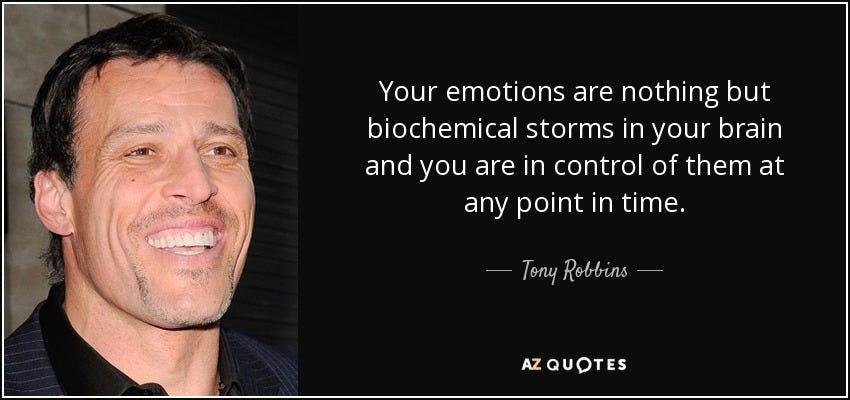
Two nearly identical people can be in the exact same situation, and one person can be sure it’s going to work out and not be worried at all, while the other is in a full-on panic mode. What’s the difference? Mostly, their approach to the world.
You can let fear break you, or you can say, “If I fear it and I shouldn’t, I must do it.” Certain emotions may rise to the surface for all of us, but you genuinely make a CHOICE about how you respond to them, and over time, those choices reinforce themselves, change your internal narrative, and shape your reality.
11. Growth requires failure the same way that gaining strength requires pain: There was a time in my life where I’d hear someone talk about their lives, say, “I have no regrets,” and my perfectionistic reaction was, “That seems stupid.” That was because I could think of all sorts of things that I wished I had done differently, because I believed it would have worked out better.
However, you come to realize as you get older that who you are is shaped not just by your victories, but by your defeats. Some people allow their failures to break them, but successful people learn, grow, and get stronger from falling short because they get up, dust themselves off, and use their newfound experience to get better.
12. The only truth between a successful person and an unsuccessful person is that the successful person has tolerated more failures over a longer period of time: Granted, there are plenty of specific cases where this isn’t true. For example, if I were somehow able to practice basketball for a thousand years and try out for the NBA each year, I would still fail at it every time because I simply don’t have the genetics needed to compete on that level.
On the other hand, an awful lot of people succeed in life because they got figuratively knocked down 7 times and got up 8 times. They kept TRYING to fix their health, get good grades in school, start a small business, or make friends, and eventually, they did. Show me the people who succeed in life, and MOST OF THE TIME, it will be the people who don’t stop trying, while the losers got knocked down and stayed there.
13. You don’t get rid of the anxiety or the self-doubt. You just learn how to develop the ability to act in spite of it: Everyone reading this has probably heard the cheesy old “two wolves” story:

Cheesy, not cheesy – there’s a lot of truth to this. There is never going to come a time when you essentially become a comic book hero who is never afraid or doesn’t second-guesses themselves. All of us have some of that to deal with.
However, do you want to know a little secret? Whatever you feed gets stronger. If you spend every day of the next 5 years telling yourself that you’re a loser, you’re terrified, and you’re never going to win, you’re going to be a very different person at the end of that than if you’d told yourself you were a winner, ready to handle anything, and are destined to win at life. Don’t give in to your weakness; feed your strength.
14. Happiness is not a lack of problems. Happiness is having better problems: If you’re wondering when life gets easy, the answer is, “never.” That doesn’t mean it wouldn’t be more pleasant to be a billionaire than living in a garbage pile in some Third World country, but in either case, you are still going to have problems, issues, and worries.
It doesn’t matter if you’re poor or rich, famous or anonymous; having your dog get hit by a car, getting badly injured, or losing a friend hurts like hell. Still, there are differences.
For example, if you had a choice between being frustrated by your inability to get from 8% to 7% body fat, that’s a much better problem than being 400 pounds and struggling to lose weight.
Don’t ever let yourself believe that you’re going to get to some certain point in life, get some particular possession, or meet some certain person, and everything is going to completely smooth out for you, because it just doesn’t work that way.
I’m 79 and still practicing. One day I’ll make a great baguette.