

First off, I don’t really know a lot about the guy who tossed out this asinine opinion. Could it be what he really believes? Rage bait for X? It’s hard to say. In any case, I’ve seen the same thing said by enough economically illiterate people/socialists (but, I repeat myself) that it’s worth addressing:

So, in order to answer the question properly, we should start by noting that working at McDonald’s is an entry-level job. It’s generally thought of as a place for high school students and people with minimal experience to learn the basics of work.
This seems to fit fairly well with their workforce since, per an article about fast food workers in general (not just McDonald’s), about 30% of fast-food employees are teens and another 30.7% are 20-24.
Although by some estimates, as few as 1-5% of McDonald’s workers are making minimum wage, unsurprisingly, it’s not a high-paying job. Although McDonald’s doesn’t officially list national numbers, ChatGPT was able to give a breakdown of what McDonald’s workers are getting paid in general:
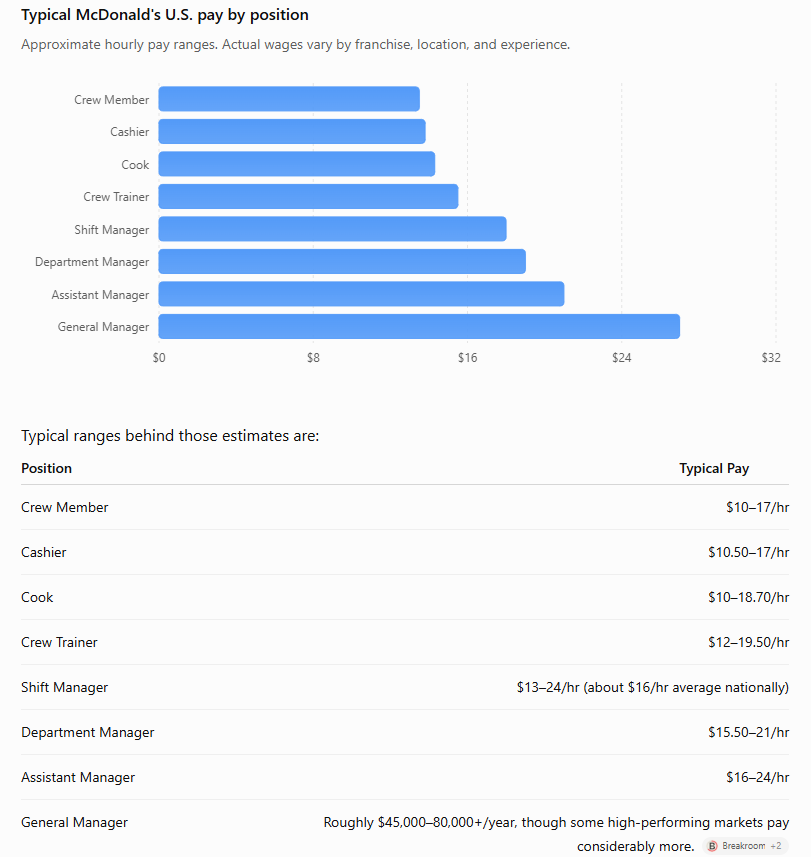
If you saved for long enough, invested it and didn’t want something particularly nice, could you get a house on those wages? Absolutely. But, that’s never what people are driving at. What they really mean is that anyone who has a job, even a job at McDonald’s, should be able to afford to get a house in a few years.
Although I’ve never worked at McDonald’s, I did work at Burger King as an employee when I was a sullen teenager and later as an assistant manager when I was an adult. So, I can tell you from experience that it is not fun work. It’s often hot in the kitchen, it feels high pressure during the lunch and dinner rushes, it can be brutal if you’re short on staff, the cleaning after your shift when you’re tired is aggravating, and the assistant managers often make less per hour than the regular employees when you consider how much time they put in to get paid their salary.
On top of that, my two biggest memories from my time as a Burger King assistant manager were how badly my feet hurt after standing for 10-12 hours per day and having them schedule me for the super early breakfast shift one day, lunch another day, and super-late dinner on the third. This happened frequently.
So, doesn’t that mean all those people deserve to be able to afford a house with their wages? Doesn’t that mean I should have been able to afford a house with my wages?
No.
Because that’s not how houses work, wages work, or the economy works.
That’s like saying, “Jenna had a rough year! She was sick for three months, she had to put her dog down, her marriage broke up, and her best friend stopped talking to her. She deserves to be given a house!”
No, she does not because again, that’s not how houses work, wages work, or the economy works.
Like a car, a Gucci purse, a computer, or a Japanese A5 Wagyu steak, you “deserve” it when you have earned enough money to pay for it. Anything else is charity that comes at someone else’s expense.
There are really two ways you can look at wanting something and being unable to get it as a human being.
The first is the traditional American, very capitalist response, which is, “I need to build my skills so I can make more money and buy a house.” This is a way of looking at things that makes you into a more useful person and a better citizen.
The other way of looking at it is the more un-American, socialistic approach, which says, “I think people should have this thing, so we should mandate by law that it be given to them or that they be given enough money to buy it.”
This is, for example, the approach that the Soviet Union took to housing. They built hideously ugly apartment buildings full of tiny apartments with minimal features, and then they had long waiting lists to get into them. It was not uncommon to have 4 or 5 people in a 400 square foot apartment or sometimes, even in a single room:
This is where this kind of thinking eventually leads you if you take it to its ultimate conclusion. The same goes for socialism and a “living wage,” which is really nothing more than an arbitrary number picked out of a hat that will quickly become outdated.
For example, if the law said the “living wage” had to be $100, that’s the new “minimum wage,” no one with any skills is going to work for that amount. If your plumber is getting $80 an hour today, he’s probably going to ask for $800 after the living wage becomes $100 – and he won’t be alone. Next thing you know, there will be calls to raise the “living wage” again.
That doesn’t mean there aren’t ways that we can help people get a leg up. Trump’s “no tax on tips” and “Trump accounts” do exactly that. Deporting millions of illegal immigrants will also quite literally lower the demand, and therefore, the cost of housing. Getting rid of rent control, rent stabilization, and lightening up zoning laws will lead to more housing being built, and therefore, reducing the cost of housing. More drilling for oil and increasing the amount of coal, natural gas, solar, and nuclear power will reduce energy bills. Pro-business environments in red states are pulling in corporations from blue states, which increases salaries and the number of people working in red states.
You don’t make life better for most people by giving their power to the government or trying to legally mandate that the market give people things they don’t deserve. You make life better for people by helping them build skills and by putting an environment in place that allows them to better their own lives more easily.
The fix is not and never has been “more government” and “more mandates.” It’s less government and more people reaching their full, God-given potential as human beings.
Capitalism is not perfect but it matches with basic human psychology. On average, we are lazy and most would gladly do the minimal amount of work to survive. Most need external sources of motivation to do most anything. Why spend the time learning skills and gaining experience if it does not lead to better pay? If an unskilled factory worker earns the same as a doctor, who wants to spend the 10 plus years it takes to become a doctor. The easier path would be to work in a factory.
A corollary is people rarely take care of things that are free. There is no cost to destroying something that is free if you can replace it with another that is free.
I have seen this in my career as a teacher. When my grandparents and parents were in school, students had to buy their books. If their family was too poor to afford it, the students could earn the money to exchange for books by working various jobs at the school. At the end of the year, they could sell the books back to the school for as much as 80% of what they paid if they kept them in good condition. Often, families would get together to trade books and many churches had textbook libraries that one could borrow from by giving a deposit on the book that they would get back in full if the book was returned in good condition.
Court rulings and Federal and State laws put an end to that. Public education had to be 100% free. During my teaching career, it became common for students to be given a brand new book at the start of the year and by the end, it was totally destroyed. The student's account would be charged for the book, but there was no real way to collect it. The only sway the district had was to not allow students who owed money to walk at graduation. That was a privilege, not a right. They still earned their diploma.
Tbe way around this was to change school districts. Students who had racked up huge fines could simply move to a different district. The district they came from had to forward their academic records so the students had no incentive to pay the debt and they could walk at their graduation.
The only time this did not work is when a student transferred from a private to a public school. If they owed a debt to the private school, the private school could withhold all academic records until the debt was paid off. I had one student who transferred to my school for their senior year. The student was kicked out of the private school for cheating. Because the student owed money, the school refused to forward the academic records until the debt was paid off. That student had no credits towards graduation at that point and faced the prospect of starting their senior year in all freshman classes. It only took a month for the family to find the money to pay off the debt to get the transcripts released.
During my career, we went from students having to provide their own paper, pens, and pencils to the state mandating that the schools provide these free of charge. My last 4 years of teaching, about a fourth of my students had no problem picking up a new pencil at the start of class and then breaking it by the end of class or simply tossing it on the floor or the garbage on the way out because they would get a new one at the start of the next class.
A few years ago the district thought it would be a good idea to issue every student a Chromebook. The problem is students have no incentive to take care of them. If they forget to bring theirs to school, they, by law, have to be given a loaner for the day. If a student destroys their Chromebook, their is no way to enforce the rule that they have to pay for the damage and by law they have to be given another one so we do not interfere with their education.
Translate that to housing. Why are most public housing projects destroyed within a few years? The people housed in those projects have no incentive to care for their apartment. If they destroy something, it is fixed for free, if there is the money available. If the apartment becomes uninhabitable, they are simply moved to a different one when it becomes available.
My generation had to work to buy our first car or were given a cheap, beater car by their parents who made their kid pay for everything required to use the car. This meant getting a job and learning to do your own repairs.
I was given my mom's 1965 Mustang that was on its last legs in 1977. The engine needed replacing. I had use my money to buy a good running engine from a junkyard out of a wrecked 1974 Maverick then swap the engine myself. As most boys of my generation did, we helped each other with these projects on the weekends. I was fortunate, my step-father was a mechanic and auto body person, so he helped me also. He then helped me repaint it on a weekend in his shop that he had recently purchased. It was not free. I had to spend time at his shop after school or on weekends to work it off. I got lots of experience in repair cars. I learned the value of work and taking care of my possessions. I also got to spend a lot of time with my step-father who listened to me about my problems and gave good advice when needed. He helped me through a very difficult period of my life.
That is why I still find it to be therapeutic to do physical labor when I am troubled about something. It works off my anxiety and gives me time to think.
This experience also is the reason why I drive a 1993 4Runner today that I bought used in 1998. I take care of it and it serves my purpose as a daily driver and for weekend fishing trips. I taught my son to drive with that 4Runner. It is a stick shift. For awhile, when I was off of work recovering from a stroke, he drove it to high school. He was the envy of his friends because he could drive a manual transmission.
I still have it because I learned a long time ago it is cheaper to fix than to buy another, even if the cost of fixing is more than the value of the vehicle. I avoid the depreciation associated with a newer vehicle, my insurance is very cheap, and the registration is also cheap. I just moved to a state that allows permanent registration for vehicles older than 11 years, so I will never pay registration on it again. I recently had the engine and transmission replaced for less than the cost of an average used vehicle. I have 300,000 miles on it and it will go another 300,000 easily. What I pay in annual repair costs is less than I would spend on car payments for 3 months.
Contrast that with my brother who buys a new vehicle every few years because he never does the basic maintenance and repairs on them. He can buy a brand new vehicle and in three years it is ready for the junkyard. He has destroyed many an engine by not changing the oil regularly or running out of oil because he never checks it. I have had a total of 4 cars in 50 years. He has gone through well over 20 in 45 years. He has been making car payments for over 40 years. I have not had one since 1995, when I realized that it is better to save the money to purchase for cash. The last vehicle we purchased was for a vehicle for my wife and we paid cash for it 15 years ago and it is still running strong even though it is 17 years old.
I will take capitalism without safety net over socialism or communism any day. I have had a few financial set backs along the way, but capitalism has provided the best way for me to recover. Government intervention would have gotten in my way and likely doomed me to being financially dependent on the government. No thank you! I do not want to be a slave to the government.
Amen, John.