

The idea of waiving income taxes for a large percentage of Americans feels like it may be starting to pick up steam on both sides of the aisle.
Donald Trump has floated the idea of using tariffs to replace all income taxes several times. Incidentally, that is how it used to work in the early days of the United States, long before the income tax came around in 1913:
However, Trump’s proposal isn’t realistic because there’s an enormous gap between how much money tariffs are bringing in and the amount of revenue the government collects with income taxes. Without massively cutting spending or dramtically raising tariffs, we couldn’t come close to replacing the amount of revenue raised by income taxes, and realistically, both things are highly unlikely.
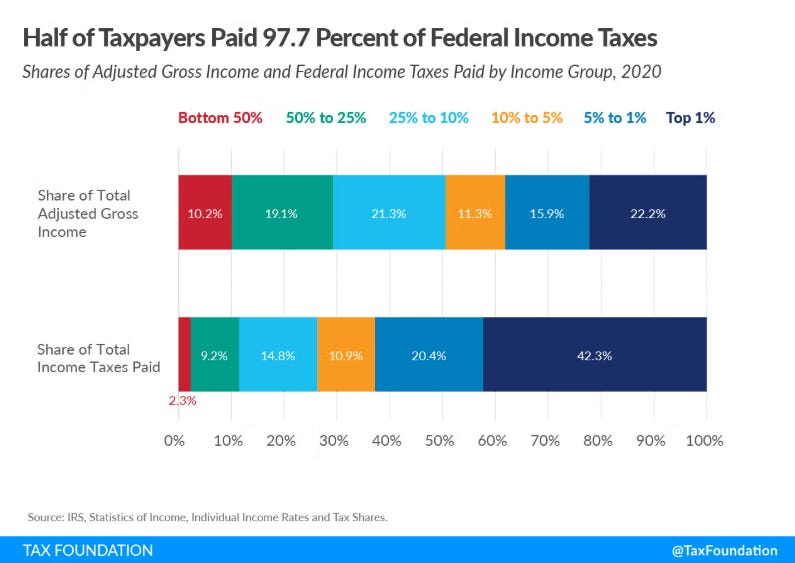
That being said, could tariffs replace what the bottom 50% of Americans pay in income taxes? Absolutely, because despite all the claims that rich Americans don’t pay their “fair share,” the truth is that percentagewise, the bottom 50% don’t account for a major share of our income tax revenue:
Jeff Bezos, who founded Amazon and is now the world’s 4th richest man, has also gotten in on the act recently and you’ll notice that Cory Booker already has proposed a bill that could do something similar:
Jeff Bezos is calling for a dramatic rewrite of the US tax code, arguing that the bottom half of American taxpayers should pay no federal income tax at all. Speaking Wednesday in an interview with CNBC International’s Andrew Ross Sorkin, the Amazon founder said he would “advocate” for reducing the federal income tax burden on lower-income households from roughly 3% of total tax collections to zero.
“I think it should be zero, and not 3%,” Bezos said after Sorkin noted that the top 1% of taxpayers contribute about 40% of all federal income tax revenue, while the bottom half account for roughly 3%.
...Data compiled by the Tax Foundation using the latest IRS statistics show that the bottom half of taxpayers reported adjusted gross income of roughly $54,000 in 2023 and paid an average of $913 in federal income taxes. Their effective tax rate was 3.7%. By comparison, the top 1% earned at least $676,000 and paid an average federal income tax rate of 26.3%.
Bezos’ comments come as several lawmakers push tax relief for working Americans. Cory Booker has proposed the “Keep Your Pay Act,” which would exempt the first $75,000 of income from federal income tax for many households.
In other words, what we have here is something that is actually doable, that would be politically popular, and that would inarguably help a lot of the people who need it most. Additionally, with all the concerns about AI taking jobs, this could be a hedge against that, at least to a certain degree. Furthermore, we’re not talking about giving people welfare here; we’re talking about allowing them to keep money that they earned. There’s a moral case to be made for that.
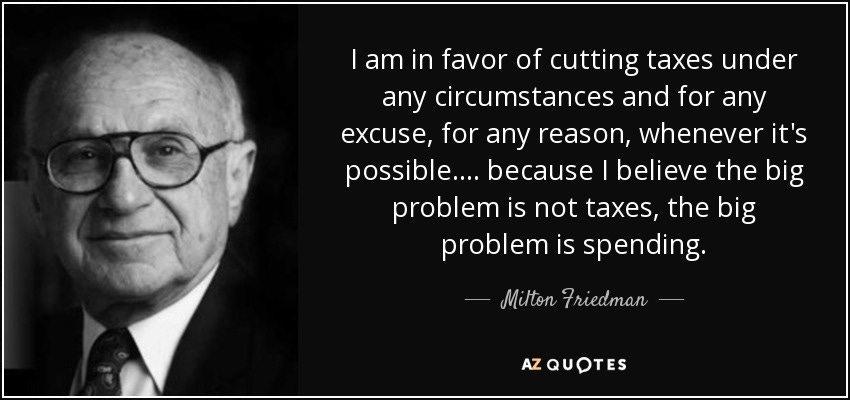
Those are all good arguments for this policy, and of course, we can’t forget what legendary economist Milton Friedman said:
That being said, there are still some rather obvious problems with this from a common sense and good governance standpoint, although things like that seem to mostly be ignored these days when it comes to policy.
As a starter, the very fact that we have a progressive tax, instead of a flat tax, is a big part of the reason our spending is so out of control in the first place. If everyone paid the same percentage, everyone would also be heavily incentivized to protest wasteful government spending because we’d all want the percentage of revenue we paid in income taxes to be as small as possible.
By creating a progressive tax system, we’ve created a world where people paying very little in taxes see no problem with massively increasing government spending for the most frivolous reasons imaginable because they quite correctly understand that they won’t be the ones paying for it.
Getting rid of income taxes for the bottom 50% of Americans would be like putting that problem on steroids because suddenly half the country would be able to vote for politicians who would give them things that they would be sure that they wouldn’t have to pay for at all.
The only way this would definitely be a good idea would be if people who didn’t pay income or capital gains taxes also didn’t get to vote. Is that in the cards? No, so this policy runs the risk of essentially turning the taxpaying half of the country into a slave class for the people who don’t pay taxes. You know, “Don’t be so greedy! We need to raise your taxes even higher so we can give the 50% of Americans who don’t pay income taxes more free stuff at your expense.”
In other words, we seem to increasingly be headed in a direction that will genuinely benefit a lot of Americans at first, but that will also ultimately lead us further and faster toward a debt-fueled economic collapse. Our only hope of avoiding that is getting our spending under control, and this policy would make that even less likely.
So, would this be popular? Yes. Would it genuinely help a lot of people? Yes. Is it likely to be good for the country? No. Not at all.
I'm a dittohead to what Humdeedeed said 3 comments below. I'd be for it so long as they could no longer vote. The corollary to the proto-communists like John Adams' and George Washington's mantra ("No taxation without representation") is "No representation without taxation."
When I was a kid, my father bought me a little red wagon for my birthday. I was thrilled.
Father told me to watch how many of my friends wanted to PULL the wagon as opposed to how many of them wanted to RIDE in the wagon and that this would help teach me what is wrong with democracy.
I’m all for it IF the bottom half don’t get to vote. As you said, that will never happen, which is really just too bad. There are a huge number of people in this country who should NOT have the privilege of voting.