

Ben Askren is a legend in combat sports.
He was an NCAA Division I champ, went to the Olympics, was a champion in both Bellator and ONE, competed in the UFC at the end of his career, and capped off all of that by losing BOTH OF HIS LUNGS, getting a DOUBLE LUNG TRANSPLANT, and coming back for one more wrestling match after that:
Does this mean Askren won every fight? Not at all. In fact, later in his career, he had a couple of particularly humiliating defeats.
He lost to Jake Paul in a boxing match early in his career, back when pretty much nobody realized Paul had at least SOME SKILLS as a boxer:
Worse yet, Askren was on the receiving end of one of the most iconic knockouts in UFC history. A brutal flying knee from Jorge Masvidal right at the beginning of the fight. It set a record for the fastest match in UFC history:
In other words, despite all of his success, this is not a man who has spent his life sailing through calm waters from one goal to the other. He’s faced some genuinely brutal setbacks and turns of fortune.
So, when Ben Askren says something like this, people should pay attention:

For the vast majority of human existence, you really didn’t have much of a choice other than to struggle because people were dirt poor, most of the creature comforts we have didn’t exist, and people either had to hunt or subsistence farm to eat, neither of which is a lot of fun once it goes from “optional for a few days” to “do this day in and day out if you want to live.”
When you live in a hut with a dirt floor, are tilling the fields at dawn, don’t have air conditioning, Internet, or enough to eat, and are always a little scared some other tribe, group of bandits, or nasty tempered nobleman will get offended and kick your head in, you don’t have a lot of options OTHER THAN to get well acquainted with suffering.
Even in previous generations, it wasn’t so easy. For example, across the course of my life?
I’ve nearly died twice, I’ve had a cop point a gun at me at a protest rally I was covering, I’ve gotten into multiple fistfights (I fractured a kid’s arm in one of them and the b*stard deserved it), I’ve been hit in the face countless times sparring which produced black eyes and bloody noses, I’ve failed college courses, I’ve been lost in the woods, I’ve walked around in two foreign countries where pretty much no one knew English, I’ve slept in an elevator overnight before, had a negative balance on my bank account, had online mobs come after me, I’ve been threatened with lawsuits several times, I’ve had to fire friends, put in 80-hour work weeks for a year, faced numerous death threats and hundreds of people sending me messages saying I should be killed, had Facebook cooperate with the New York Times to do a hit piece on me, I’ve had people I love die, I’ve lost best friends, I’ve been called up to a stage unexpectedly to talk in front of hundreds of people at a Newt Gingrich rally when I was just trying to go to the bathroom, I’ve broken a leg, had veins stripped out of both legs without oral pain meds, bled so much out of a hole in my stomach it looked like someone died in my house, have gone to the door with a gun in my hand because I thought I might have to shoot someone, asked out numerous women and had them say “No,” had a condom break when I was having sex with a girl I just met, had my heart broken multiple times, etc., etc., etc., etc. – I could go on for another thousand words.
Know what this makes me on the “tough life” scale? Mid- or high-mid for an American, maybe? Certainly, my own grandfather who fought in WWII, my father who lived through the Depression, and my uncle who fought in Vietnam had it several orders of magnitude rougher than me. So do a lot of people.
But, you know what? I don’t get upset because someone says something mean, the person at Chipotle gets my order wrong, or because I have to do something painful (I had a massage TODAY on a relatively minor injury so brutal my therapist said she was surprised I could talk through what she was doing to it). I’ve at least had it tough enough that it’s extremely rare for me to get anxious or overly worried about how things are going to play out because I always assume I can handle every situation, and so far, I’ve turned out to be right every time.
That’s what happens when you make it through tough times. You realize, “If I could do all that, this is probably going to be a cakewalk, and even if it’s not, I’ll be fine.”
Today? Far fewer people have those kinds of experiences.
We have had a lot of kids who grew up facing very few challenges in many ways. They live in a comfortable environment; mom, dad, or other adults are nearly always supervising them, and they rarely encounter ideas or tough situations. Many of these kids really don’t even have to be bored for 5 minutes because they always have a cell phone they can whip out to play games, chat with their friends, or watch videos.
While it’s understandable that parents want to “give their kids a better life than they’ve had,” it’s been taken to such an extreme that many of these kids are generally incompetent.
How incompetent?
Well, Abigail Shirer, in her book, Bad Therapy: Why the Kids Aren’t Growing Up, describes how many of these kids struggle with “challenges” that people from older generations never even viewed as challenges at all:
The rising generation is strikingly different from those prior, according to academic psychologist and author of several books on Gen Z, Jean Twenge. It isn’t simply the rates of diagnosed mental illness that make them so distinctive. They are far more obedient to authority, agreeable, and tied to Mom. More politically radical (more likely to favor far-left positions) and much less inclined to self-aggrandizement than, say, millennials. Actually, what seems to motivate a large portion of Gen Z, born between 1995 and 2012, is not hope or optimism or belief in themselves—it’s fear. They are arguably the most fearful generation on record. In April 2021, I met Twenge at her San Diego home to profile her for The Wall Street Journal. I wanted to learn more about a generation that had already started to seem awfully troubled. We sat on damp plastic chairs, ten feet apart, in her lush backyard while the pandemic raged around us. Gen Z, Twenge told me, is far less likely to date, obtain a driver’s license, hold down a job, or hang out with friends in person than millennials were at the same age. In 2016, high school seniors spent up to an hour less per day hanging out with each other than those of the 1980s. They also engage in the least amount of sex (while arguably having it most available)[62] and report having the fewest romantic relationships or romantic encounters.[63] They are reluctant to cross the milestones at which previous generations eagerly launched themselves. As one young person said to me, expressing a sentiment I heard echoed by others, “I was very scared to start college. But I guess everyone was when they were my age?” Actually, I was there. No, we weren’t.
By the way, some of these kids are much less functional than that. For example, this is something a music teacher was telling Shirer in the book:
“In greater numbers than teachers ever remember seeing, they can’t or won’t do for themselves. David offers me two recent examples to prove his point. At his students’ first concert of the year, a succession of boys approached him with their clip-on ties in hand, unsure how to fasten them. They weren’t asking how to tie a Windsor knot; he wanted me to know. They wanted him to affix their clip-on ties.
“One of the moms looked at me. She’d seen me doing this all day long, and she’s just like, ‘These kids are helpless.’ They’re literally fifteen and sixteen years old. And it’s like you’re dealing with an eight- or nine-year-old.”
At another recent competition, David was stuck in meetings, so he told his high school students to get themselves lunch. One sixteen-year-old boy came to him and told him he didn’t know how. “There’s a Chipotle right across the street,” David said. The boy had money with him. But he didn’t know how to procure lunch for himself. He had made it sixteen years without ever having entered a shop alone and bought himself a sandwich.
Incidentally, I’ve heard similar things from surprised parents I know. Kids that can’t walk into a store and order things for themselves. Kids that are too nervous to call someone they don’t know on the phone. Kids that don’t feel comfortable driving somewhere they’ve never been without someone in the car with them.
Is it a surprise that kids like this are anxious? Are depressed? View the world as a scary, intimidating place that’s nearly impossible to deal with? When you’re afraid all the time and things other people are doing look like insurmountable challenges to you, is it a surprise that this leads to mental problems?
People may not want to hear this, but we all NEED to try and fail, hurt, and suffer to be healthy human beings.
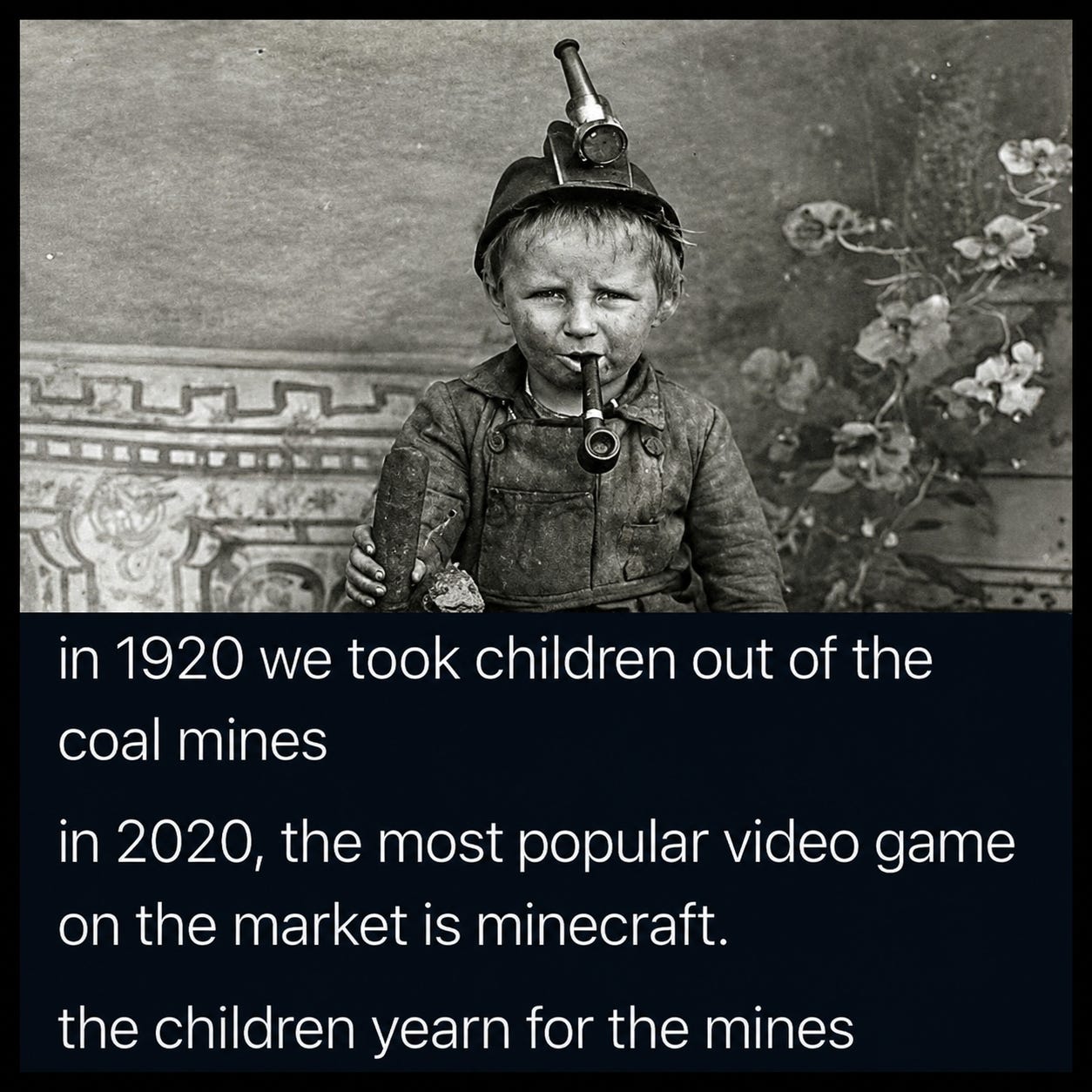
By the way, I’m not talking about slapping your kid around, locking your kid in the closet, or making them work in the coal mines:
Give them some challenges. Assuming they’re semi-responsible and you don’t live in Compton, at 12 or 13 (if not earlier), let them stay home alone or walk a few blocks to pick up something for you at a store. Put them in competitive sports leagues, tell them to go outside and play for a few hours, and push them to do things they need to do that make them uncomfortable. Also, don’t send them to a therapist who may screw them up or assume they’re “traumatized” just because they seem sad for a few days.
Life is a nasty business, my friend, and it grinds fragile people to dust. Whether that’s your kid or it’s you, one of the keys to getting back on track mentally is often just taking on and accepting challenges that make your life bigger. You don’t have to be fragile, incompetent, or live in fear if you don’t want to do it.
Granted, this won’t fix EVERY PERSON’s problem, but most people? Yeah, it will.
This is the biggest reason why there’s such a huge difference between the number of people with mental illnesses today and past generations. Back then, they didn’t have the option to avoid challenges, which made them tougher, more resilient people. Today, people often have to CHOOSE to be challenged. If you want to be mentally healthy, that’s exactly what you should do.
Some memorable and meaningful quotes:
The Apostle Paul: "Suffering buildeth endurance and endurance buildeth character."
Sophocles: "All praise to Zeus who, setting man upon the path of mortal life, made this a changeless law: that man shall learn by suffering."
My paternal great-grandfather William Baylis Dickson enlisted immediately in the Confederate Army when Lincoln declared war. He was wounded 3 times, once severely. Each time he was wounded, he went back to his unit. He fought at what the North calls First Bull Run. He never stopped fighting. He was with his unit and in uniform at Appomattox when Lee surrendered. He hadn't had anything to eat for 2 days. He later recorded his gratitude that a Yankee soldier gave him something to eat. He walked 400 miles through the devastated South to the ruins of South Carolina on the scraps of what remained of his shoes. Strangers along the way shared what little they had left to eat with him and other veterans on their way home. Everyone understood the pressing necessity to get the veterans home and to start trying to rebuild. There was no time for him to immerse himself in self pity and enroll in therapy. He did not have time to "find myself." When he got home, he had to get out of bed the next day and set immediately to the task of plowing and planting. It was already May and past normal planting time. There was hardly enough food for people to survive. The immediate imperative was to set to planting ASAP so that some of the crops could come to fruition before the growing season ended. As one of the depleted supply of surviving males, he squeezed in the time to quickly find a wife (and he found a very good one from a prominent, well respected family who made him a wonderful wife) with whom to start a family.
This was not an unusual history back then. But it stands in the starkest contrast to our own times when people just can't cope, suffer from crippling depression, labor under the burden of post traumatic stress disorder and are signed up by the 10s of millions in therapy.
Quite a difference.
I do not look upon such sufferers without compassion. I myself have shared some of their weaknesses (depression) to a small degree but sufficiently to understand that this suffering is real.
However, the clear import of this shows that we are weak because we have it so easy. We have the option to indulge ourselves by brooding on our sufferings.
Suffering is indeed a changeless law. We grow through suffering. LIfe is not painless. A pampered, soft existence in not a recipe for real life. Suffering buildeth endurance and endurance buildeth character.
I heartily recommend Jonathan Alpert's book "THERAPY NATION" which sets out how therapy instead of helping people toughen up and heal has become a way to keep stuck in the doldrums and prolong adolescence.
My great grandfather was a devout Christian, an observant member of the Presbyterian Church, the Frozen Chosen, a member of the Predestined Elect.
He had a favorite poem which he often read and recited that reflects an optimistic Christian view in the face of adversity. We still recite it in his memory at family reunions.
The 37th Psalm. Take time to read it and make it part of your life.
"Fret not thyself on account of evildoers nor be thou envious of the workers of iniquity...."
I grew up in a totally dysfunctional family. Born in 1946 I was the product of a wartime liaison which left my biological father out of the picture. When I was still an infant my mother married a man for "respectability". He never adopted me but could have and to him i was the "red headed stepchild". He and my mother went on to have three other daughters of which the first was his pride and joy. Over the years he became a hard-core alcoholic. At times we had no food in the larder nor heat in the house and we lived in PA. Through it all I remained positive and enjoyed my life in spite of all the negatives. What's not to like about living in the Lehigh Valley of PA (Bethlehem). A beautiful place. The summer before my senior year in high school my grandparents had decided they had watched their daughter and grandchildren do without long enough. Mother would not leave. him. She was an enabler and seeing her children do without did not take precedence over giving her paycheck to him to spend at Joe's Bar and Grill. Mother was a nurse. Admitting she had made a bad choice did not even occur to her. So we were moved to Wilmington, DE, where my mother's family were now living. I loved my grandparents and living a block away from them was a dream come true but it did mean leaving my boyfriend whom I had dated my junior year. No one asked me how I felt about leaving. You just did what you had to no questions asked. I did not waste my senior year moping over what I had lost. I loved living in PA and not so much DE but made the best of it and had an enjoyable senior year. I now live in Texas. Not my favorite place climate wise but politically it works for me. I've been married 46 years, have two children and four grandchildren and am content. Yes there is a lot going on around me but I know that no matter what I will survive. I learned from my youth just how much you actually need to survive and as long as my family is well I'm good.