

Now that socialist Zohran Mamdani is the favorite to become the next mayor of New York City, socialism has been in the news a lot lately. Furthermore, liberals, who are mostly indistinguishable from socialists anyway, are stepping up to embrace him as an example for the whole Democrat Party:


Of course, a socialist winning one of the most famously liberal cities in America isn’t exactly a shock, nor does it seem to be a recipe for victory in most places.
This is doubly true because socialism just plain, old doesn’t work. In fact, it so clearly doesn’t work, that’s socialism is really more of a political system than an economic system. If you judge socialism as an economic system, it’s a pathetic failure that has never, in all of history, taken a country from poverty to wealth.
In fact, the only time socialism ever looks viable at all is when a thriving capitalist system is built and socialism is layered on top of it, without being so overdone that it immediately destroys the whole economy. It’s like a world class sprinter that is forced to wear a weight vest. It immediately slows him down, gets worse as the weight is increased and can eventually become so heavy he can’t even move.
Why? Well…
1) Economic centralization just doesn’t work: There was a time in human history when the most brilliant minds could essentially “know everything” or pretty close. For example, I asked ChatGPT for a list of things Leonardo Da Vinci was an “expert” at. Among other things, it told me, "Anatomy, Physics, Mechanics, Engineering, Invention, Hydraulics, Art, Painting, Drawing, Perspective and Composition, Mathematics and Geometry, Proportion and Symmetry, Golden Ratio Studies, Natural Sciences, Botany, Geology, Zoology, Flight Dynamics, Architectural Design, Urban Planning, Fortification Design, Writing and Thought and Scientific Observation." Granted, Da Vinci had an amazing mind, but the world was also much simpler, and the base level of knowledge was a tiny fraction of what it is today.
On the other hand, today, the world is highly technical, deeply complex, and rapidly shifting. Even if you were the greatest genius on earth in, say, quantum physics or rocket science, that wouldn’t mean you’d have even the most basic understanding of something like farming, brain surgery or, social media marketing.
So, when politicians and bureaucrats, who are frequently no smarter than even the average person, are asked to make decisions about a wide variety of jobs, resources, policies, and regulations, the results are inevitably going to be disastrous.
It’s tricky enough for even true experts in a field to figure out the best way to use their resources or what the market will want in a couple of years, so when you move almost all of those sorts of decisions into the hands of people with outside agendas, who don’t understand what they’re doing, it’s going to get extremely dysfunctional, extremely fast.
Capitalism deals with this by leaving as many decisions as possible in the hands of the market, while socialism deals with it by failing over and over and over again and shifting the blame to non-socialists, businesses, and capitalism.
2) Socialism assumes something that never proves to be the case - that government is more efficient than the private sector: The government is dumber, slower, and less competent than the market in every area. The post office can’t compete with FedEx, the DMV can’t compete with Walmart, and the IRS can’t compete with Amazon.
Why? There are so many reasons. It’s not their money. Bureaucrats are more concerned with ass-covering than achieving anything. Government union workers are mediocre. Endless rules. Lack of knowledge. It goes on and on.
This is why, for example, Zohran Mamdani's calling for government-run grocery stores is such a laughable idea. Most grocery stores already have a profit margin of less than 3%. How are people who know less about the grocery business than the people running them to going to put a bunch of union workers and government rules in place and offer noticeably cheaper groceries to the public? The only possible way that can happen is that they take a huge loss and make up the difference with tax dollars. It’s obviously a horrible idea, and everything socialism takes over from the market has these same kinds of problems.
The government is so inherently inferior to the market at doing everything that the only things it makes sense to use the government to do are things we can’t trust the private sector with. Say, putting together a police force or building a sewer system there’s no real financial incentive for the private sector to maintain.
Smart people look at the government as a necessary evil, while socialists look at it as “good,” which is why they always think the solution to one problem created by the government is another, usually much more expensive, program created by the government.
3) Socialism rewards laziness and a lack of productivity: Just as you get less of what you disincentivize in a society, you get more of what you incentivize – and what you incentivize under socialism is lazy, go-through-the-motions, parasitic behavior. Socialism is all about looting the most productive citizens in a society in order to reward the least productive citizens in a society.
If you can do nearly as well not working as working, why work? If the government does everything for you, why bother to do it for yourself? What’s the incentive to be better? To strive to get ahead? To serve your fellow citizens by creating a new product or business? There is none because excellence isn’t rewarded, while mediocrity, which is admittedly much, much easier, certainly is. If you do the bare minimum and get rewarded almost as well as your neighbor who is working himself to death, then it’s going to become obvious to everyone that it’s much smarter to be like you than your neighbor.
4) Socialism creates unsustainable levels of spending: This is one of the most famous quotes about socialism:
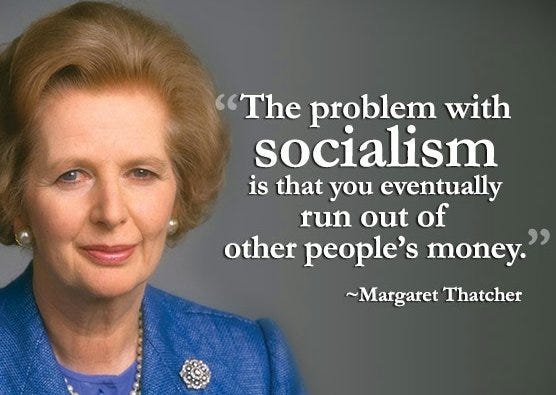
Why is this true? Because the answer to every problem under socialism is, “spend more money” and “raise taxes higher” on successful people. Ray Dalio has written about societies that do that and how it tends to play out for them:
Those places (cities, states, and countries) that have the largest wealth gaps, the largest debts, and the worst declines in incomes are most likely to have the greatest conflicts... Facing these conditions, expenditures have to be cut or more money has to be raised in some way. Who will pay to fix them, the “haves” or the “have-nots?” Obviously, it can’t be the have-nots. But when the haves realize that they will be taxed to pay for debt service and to reduce the deficits, they typically leave, causing the hollowing-out process.
It’s extremely easy for wealthy people to leave a city like New York, and although it’s tougher to leave the United States, the richest people also have the best accountants money can buy, and they’re going to take advantage of every loophole in the law. In other words, under socialism, spending goes up like a rocket ship, while tax revenue tends to stagnate or eventually even drop as rich people flee and the middle class realizes there’s no real point to putting in a hard day’s work.
5) Socialism destroys the motivation to produce: People do what they get rewarded for and stop doing things that produce no rewards. As an exaggerated example, if you said, “Doctors and fast-food workers will be paid the same,” ALMOST NOBODY is going to spend massive amounts of money, go to school for 10+ years, and take on the heavy hours and high pressure of being a doctor when they could make just as much asking if, “You want fries with that?”
Money isn’t everything, but it has an enormous impact on what people do. If someone had said, “Nobody is allowed to be a billionaire,” would we have Tesla and SpaceX today? Would Pixar be around? Netflix? Palantir? Twitter? None of them would probably exist today.
Running a business is demanding. Even on my level, I spent years putting in 60-70+ hour weeks to create a successful business. There are also people who do MORE THAN THAT. Sometimes, a lot more.
If, let’s say, the government taxed successful people at an 80% rate, what would be the point of sacrificing so much of your time? Making sure that some welfare mom can sleep in every day and do nearly as well as you? No thanks. The heavier the tax burden becomes, the less incentive people have to work hard, to create new products, and to create new businesses.
It’s easy to say, “So what? Screw those rich guys! What do we need them for?” Well, you need them for jobs. You need them for tax revenue. You need them to supply products like the computer I’m typing this up on and the DSL that’s enabling me to surf the Internet at blinding speed.
The government can’t just get together a group of hidebound bureaucrats and dull-eyed government employees that can replace the sort of entrepreneurs and hungry, hard-working, highly talented, highly paid employees they tend to gather around them. High performance has to be rewarded with much more than the opportunity to help pay benefits to illegal aliens, homeless people, and 25-year-olds still living in their mom’s basement or we won’t get it.
Yeah, we all know the type of people who run to embrace an ideology where the "angels" who work for the government take money from the "demons" who work in private enterprise. Progressives, in all their envy, jealousy, covetousness and lack of ambition, will try to band together to use votes to steal from one group to give to another. I believe the US will eventually succumb to this, because we lack critical thinkers and the restraints of Christian morality, where the rich who can "get away with" stealing, and the poor who will simply steal because they have to votes to legalize it, and no one remembers that God sees, and He will pass judgment.
This is well done John.
I would also add that socialism is anathema to human nature. There is the explanation of the Hedonic Treadmill - where we set our expectations to the new normal when we achieve more to desire more. This tendency is our blessing and curse... it is the source of wars and greed that punches down or harms others less capable or less privileged (and that leads to them supporting socialism), but it is also the engine of invention, exploration, enterprise, progress and growth.
Because the driving principle of "from those that can/do, to those that cannot/don't" requires authoritarian control to prevent more capable people from achieving more, socialism conflicts with human behavior. It then requires more authoritarianism in a constant cat-and-mouse game to prevent the more resourceful people from figuring out how to work around the system to achieve more. The trajectory always leads to greater punishment up to an including death to maintain "fairness".
Conversely, democratic capitalism, not so much the corrupt global corporatist version we have today, is a system designed to exploit and serve human nature. It is the reason that communist China can demonstrate the lie that communism is a working system... because the democratic capitalism of the US resulted in so much economic growth that China could loot from it. Without the US, China would still be a 3rd world country... and all the so called socialist European countries would have a much smaller social programs because instead of the US funding their defense with the Global Order, they would have had to spend much more of their GDP on their own protection.
The Invisible Hand of capitalism is basically this exploitation of human nature... something that no collectivist ideology can deliver.