

Perhaps paradoxically, because it feels like the work ethic of a lot of people has slipped below where it used to be in previous generations, perfectionism is more of a problem than ever.
There are two reasons for that.
The more conventional one that most people would expect is that standards have risen to such an extent that we almost expect many of the most successful people to push themselves to the absolute limits of what human beings can do. When you hear that Kobe Bryant’s trainer had to stay at the gym for thirty minutes after they practiced to keep him from coming back in the middle of the night and working on his game, or that Elon Musk will sometimes get a few hours of sleep per night on a factory floor rather than go home, or that to win the title of strongest man in the world, Eddie Hall literally mapped out every hour of every day for an entire year in advance, it’s hard to conclude that anything short of your absolute best effort will get you to those heights.
However, there is another type of perfectionism that is running rampant in American society and that, perhaps surprisingly, is embraced by an enormous number of unhappy and unsuccessful people. Because social media encourages people to post the highlight reels of their lives and to judge themselves by how much attention they get from others, it causes an awful lot of people to put on a front, play a character, and try to be what they think people want them to be, not who they really are. It also causes a lot of these people to shy away from challenges or just give up entirely because they look at what it would take to achieve their perfect dreams and just say, “This is going to be way too hard. What’s the point of even trying?”
Well, yesterday, I was listening to a podcast that discussed perfectionism, and it reminded me of my days as a perfectionist.
I am someone who used to work 80 hours per week, who did not take days off, and who even worked during vacations. There was a time when I worked out with weights 7 days per week, too, and was obsessive about getting more traffic for my website. When I was younger, I also had a tendency to try to appear to be what I thought people wanted to see while pushing who I really was into the background because I didn’t think the real me would go over as well as the front I showed to the world.
Today, I am not a perfectionist anymore, and I’m considerably happier, much less stressed, and much more authentic than I was back then. Whether you read Culturcidal, see comments I make on social media, hear me as a guest on a radio show, read my book, or talk to me face-to-face, I sound like the same person. That’s because people may like it or not, but everyone gets the real me now.
So, I understand being perfectionistic, and I can tell you about the changes in the way I viewed the world that helped me get out of that unhealthy way of thinking. Hopefully, if you are a perfectionist, this can help you do the same thing.
1) It’s the journey, not the destination
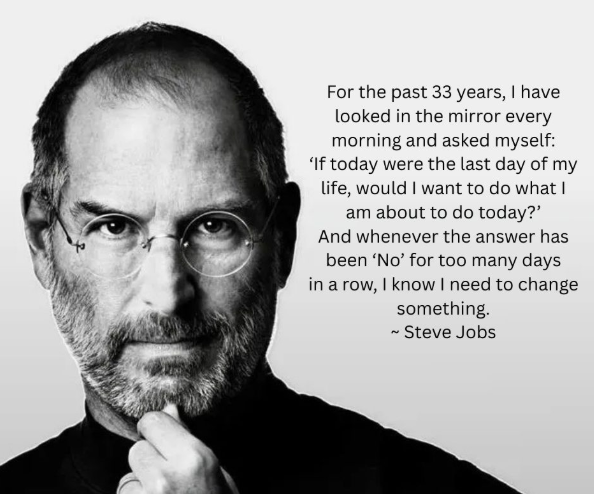
The lie perfectionists tell themselves is that if they win the event, reach the peak, get the highest grade, do the thing just right, be exactly what people want them to be, etc., etc., THEN they’re going to be happy and reap the rewards.
Except this is not even remotely true. For most people, especially people with perfectionistic tendencies, do you know what happens after your perfectionism pays off? After you win the race? Kiss the girl? Make the million dollars?
Five minutes later, you’re going, “Wow, I really did it. That’s amazing! I’m going to have a big steak tonight to celebrate or buy myself something nice. Of course, I guess then I should get back to work on doing it again, even better this time!”
Suffering short term? Sure, go do it. Sometimes we all have to suck it up and do things we don’t want to do for a while, but you should generally ENJOY THE GRIND. I’m not saying life has to always be a Carnival cruise. Ideally, you should be able to push through a good bit of work and unpleasant things and still have a good day, but life is also not supposed to be endless drudgery. Even one of the most famous perfectionists of the last century would have told you that:
2) How can you feel good about people liking you if they’ve never met the real you?
Back in the day, when pick-up artistry was a big thing, there were different approaches to getting women. Some of them emphasized a lot of canned routines, and some people took that to an extreme.
The absolute, no-holds-barred worst one I ever heard that didn’t involve just outright lying from start to finish was a guy who took every woman on the exact same first date. And by EXACT SAME, I mean EXACT SAME. They went to the same restaurant down the street. He’d take her back to his place and play the SAME MOVIE. He’d have the same cute lines he’d drop at the same time in the night.
Honestly, that’s the equivalent of going to a prostitute as far as your self-image is concerned. After all, that woman doesn’t know him any more than a prostitute would have. She was unwittingly playing a role in a play he put on to try to get her into bed, while basically he was one of those wind-up monkeys playing the cymbals in exactly the same way, over and over. There was no real “him” in the interaction.

Sure, it’s great to have people giving you likes online, paying attention to you, and singing your praises, but if they’re just praising a fake persona you put on to get a reaction, how can that feel anything but empty? It would be better to have 5 good friends who really know you and like you as a human being than a million people cheering a made-up identity you’re pretending to be in order to appeal to them.
3) Perfect is boring
All credit for this one should be given to the “Godfather of the Red Pill,” Rollo Tomassi.

Tomassi was writing about that in regard to women becoming bored with “perfect” men, but there’s a lot of truth to it in general.
Perfectionists tend to think of perfect as “the best,” “elite,” or “it couldn’t be any better,” but do you know what people who try to come across as perfect actually sound like to other people?
They sound like guarded, inauthentic try-hards—because they are. They’re not vulnerable, quirky, or real. How many times have you opened up to someone, and they’ve responded by doing the same thing? How many times have you told some story about a friend or family member that’s hilarious because of some quirky thing they’ve done? What about authenticity? It makes you feel like you know a person, while someone who sounds perfect makes you wonder what they’re hiding.
This is the ironic thing. The real you, flaws and all, is going to be more interesting to people long-term than the fake you that you’re showing them because you think it’s what they want to see. If you’re thinking, “But, the real me isn’t that fascinating,” then the solution isn’t to create a facade, it’s to work on becoming the sort of person you want to be.
4) You have to be able to forgive yourself and love yourself
The mind of a perfectionist is an endless treadmill, with a never-satisfied coach in the background making snide comments. There is no speed except “faster,” no type of work other than “harder,” and no satisfaction to be had because there’s always SOMETHING you can get better at. It’s like a lifetime of hearing, “You’re not good enough,” repeated over and over. That sounds grim, right? It’s why a lot of perfectionists tend to be unhappy people.
However, a good coach doesn’t actually behave that way. A coach who wants you to succeed builds you up instead of tearing you down. He wants you to set high goals and achieve them, not impossible goals that you can never hit. He very much wants you to win “the thing,” whatever “the thing” may be, but his first concern is ultimately what’s good for you as a human being.
I hate to get Biblical on you, but just as God forgives us when we fall short, we have to be able to forgive ourselves. Just as God loves us, we have to love ourselves enough to want something better than a never-ending treadmill. There is an enormous amount to be said for trying to be the best version of ourselves, but there’s nothing to be said for trying to be perfect.

No matter who you are, you’re going to fall short. Love and forgive yourself anyway.
5) Reject the whole idea of an “all-or-nothing” mindset
Do you know what an all-or-nothing mindset does to you?
It makes you not even want to try a lot of things because it’ll turn into too much work.
It can make a big win feel like a huge loss because of an insignificant mistake.
It leads to you feeling endlessly dissatisfied because you never get it “just right.”
It closes off an enormous number of options in your mind because they won’t lead to the maximally good outcome.
It can make insignificant setbacks feel like calamities.
It can cause you to ignore serious problems or massively exaggerate their significance.
It can completely derail an enormous amount of progress because one setback makes you feel like a failure.
It can make you feel like a loser when you’re actually winning bigly at life.
Dieting is an area where you can easily see how this type of thinking creates messes for people. Let’s say you’ve been perfect on your diet for a month. In fact, you’ve lost 10 whole pounds! Great job, but, uh-oh, someone brought a bunch of cookies to work today, and you ate one! Cookies aren’t allowed on your diet, so you CHEATED. As a practical matter, the 300 calories you just ate essentially mean nothing long-term, but what do you tell yourself? “Well, since the diet is blown today, maybe I should get a burger and fries for lunch.” Then, you eat some nachos for dinner and want to take advantage of your “cheat day” by eating some ice cream. Now, you’ve gone 3,000 calories over your diet total. That does matter. Worse yet, the next day, you go, “Well, it’s Friday, might as well take the whole weekend off and start again on Monday.” Except you don’t. You keep on eating trash. A couple of months later, you’re five pounds heavier than when you started. This happens to people ALL THE TIME.
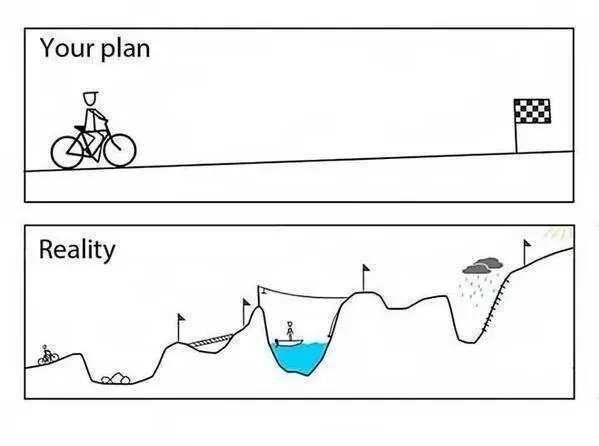
Don’t think in terms of all or nothing. Expect setbacks and don’t let them knock you off course. Like the meme says, success almost never turns out to be a straight line.
6) There are too many different important parts of life to be a perfectionist
If you read up on the elite of the elite, the most gifted human beings who became absolutely obsessed with something and made it to the top of some field, do you know what you’ll find? Even if it’s hidden from publc view, they’re almost always a train wreck in a lot of other areas. They tend to have a lot of bad habits, a tumultuous family life, and they’re often not particularly pleasant people to be around.
So, if you’re a perfectionist who has to get an A+ on every paper, outwork anyone in the building to make it to CEO, or eat, sleep, and breathe chess so that you can become the best player in the world, ironically, not only are you going to fail to be perfect in a lot of other areas, you’re going to be a below-average human in a lot of ways.
The point of this is not, “Don’t try to be the best at something.” I don’t see anything wrong with being imbalanced and pouring your heart and soul into something for a while to try to get ahead, particularly when you’re young (of course, maybe that’s the perfectionist in me talking), but recognize that succeeding at life is ultimately a lot more than just that thing.
I mean, what matters on some level? Money? Your career? Your family? Your relationships? Being liked? Leaving a legacy of some sort? Contributing to other people? Your spiritual growth? Growing as a person? Controlling your time? Your health? We could go on from there, but the truth is that ALL OF THEM are important to some degree, and the price of being a perfectionist in one is going to be neglecting a lot of the others.