

Is that investment opportunity real or fake? Can you trust what that influencer just said? Is the politician lying to you this time or not? Is that unusual looking woman really a guy? Is what you’re seeing a real shift in opinion or being created by a social media algorithm? Is that video real or AI? Is the news story you just read real or slanted? Is the supplement you just saw an ad for genuine or a rip-off? Did that podcaster say what they just said because they believe it or because they got paid to do it? Is that comment you just read from a real person, a bot, AI, part of an ad campaign, or even part of an influence campaign run by a foreign government?
Never before in recorded human history have people been beset by lies coming from every direction like this, and it makes it so difficult to know what’s real and what’s not that people are starting to have “truth fatigue.” For many people, it’s too much work to figure out what’s real and what isn’t.
This is extremely bad for society because when people don’t know who to trust, instead of trusting no one, they often just start listening to anyone who says what they want to hear.
So, how do you ferret out the truth? I hate to be the bearer of bad news, but in many cases, you don’t. When it comes to getting the truth about things that are in dispute, smart people often think in terms of probabilities: “What’s going on is probably this, but there is a chance it could also be this and maybe even that!”
Still, how do you tilt the probability that you’re right in your favor? Well, it’s certainly not simple, because a combination of experience, detailed knowledge about the subject at hand, and raw intelligence matters a lot.
If the subject is rocket science and you know nothing about it, chances are you’re not going to be able to evaluate it very well. If the subject is farming and you’ve read three books on it, but you’ve never actually farmed, you may be easy to fool. If someone is talking about the war between Ukraine and Russia and you think those countries are in Africa, you don’t have much hope of getting to the truth.
Once you get beyond that, a lot of determining the truth comes down to the questions you ask. Questions like…
1) How credible is the source of the claim, and what is their motivation? Are we talking about a claim made by a newspaper or podcaster based on an anonymous source? A rando on the Internet? A divorced woman being asked about her husband? An article created by a liberal think tank full of claims that reflect badly on conservatives? A conspiracy theorist? A criminal who says his friend was shot by a cop after saying, “Hands up, don’t shoot?” A representative of a supplement company telling you about how great their new product is? Is there real video or confirmable proof that you can see for yourself or do you have to basically take their word for it?
Some sources should be treated as extremely suspect from the beginning. On others, the topic matters a lot. I’d believe movie times for a theater in NYC printed in the New York Times but would be highly skeptical of claims they made about politics.
You also have to remember that in the modern world, very few people are truly trying to appeal to everyone. Everybody has a niche, and that niche has usually CAPTURED THEM. By that, I mean the vegetarian podcaster isn’t going to tell you how great meat is, the conservative radio host isn’t going to talk up Hillary Clinton, the anti-Semitic guy on X isn’t going to admit Israel is right, and Chrysler isn’t going to tell you if they think Ford makes a better car.
If you don’t understand what the slant of the source is, you don’t have much of a chance of really getting to the truth.
2) What is their track record? One of the weirder tics of the modern world is how many people simply don’t seem to care if the news sources they’re following are accurate or not. This used to be THE METRIC people evaluated news sources by, but today, at best, it’s a distant third behind entertainment value and telling people what they want to hear.
If you don’t penalize sources for regularly getting the story wrong or outright lying, you’re going to constantly be fed lies. Unfortunately, a big slice of the American population falls into this category. Is it a majority? A large minority? It’s hard to say because no one wants to admit that they don’t care about the truth, but it’s not a small number of people, and they make the world a worse place for all of us by making dishonesty monetizable.
3) How does their claim compare to competing evidence? Sometimes there isn’t a lot of competing evidence (Example: “I woke up, looked out my window, and saw Tom and Paul Jenkins toilet papering my house at 3 AM.”), but oftentimes there is. If someone tells you that our own government knocked down the Twin Towers, Charlie Kirk was killed by someone other than Tyler Robinson, or that the Earth is flat, their explanation needs to be BETTER THAN the accepted, heavily documented, conventional wisdom. As the saying goes:
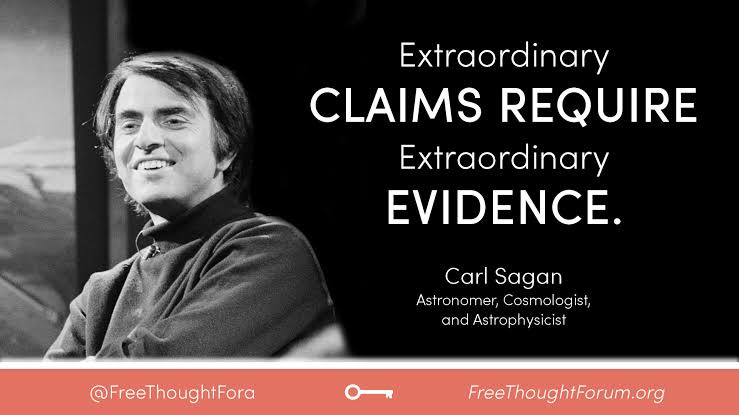
If it doesn’t meet that standard or, even more importantly, doesn’t even try, it is unlikely to be true.
You may notice that properly evaluating these claims requires you to understand the other side of the argument well enough to compare it to the claim that’s being made. If you can’t do that, if you can’t effectively argue the opposing position, you’re not even in a position to evaluate what’s true and false in the first place.
4) Is it verifiable? There are a lot of people out there who claim to have “special knowledge” based on everything from access to anonymous sources to dreams. These people are usually full of sh*t.
For every person who genuinely has some special knowledge, there are probably 50 that are liars, propagandists, or nuts – more like 100+ if you’re talking about people on social media.
If it’s real, the source will be making great strides to provide strong evidence for what they’re saying that holds up under scrutiny, you will be able to find reliable sources pointing out the same thing, or at least you will have smart, trustworthy, non-flaky people going, “Yes, this could be the case.” If you have none of that, it’s highly likely to be fake.
5) Is it the whole truth? I’m very interested in health and longevity research, and so, if I see some really big claim on social media about some drug, supplement, or therapy that interests me, I will dig deeper into it to see how true what’s being said happens to be. Want to know how many of them seem to be almost entirely true? Pretty much none of them, although a lot of them will be based on grains of truth. There will be ONE STUDY that shows some promise in some area, then someone will extrapolate from those results and declare that if that’s true, something else which sounds much better must be true – except it isn’t.
Of course, there are lots of other ways to lie with a partial truth. Remember, the “very fine people” hoax, where Trump seemed to be saying the white supremacists at Charlottesville were “very fine people?” Except, when you look at all of what he said, he was actually saying exactly the opposite of that:
How about when Nick Sandman was falsely portrayed as intimidating an Indian activist who walked up and got in his face? They showed you the video, but not all of it. They told you the story, but they left out a lot to trick you into believing the narrative they wanted to push. Incidentally, both the WAPO and CNN settled with Sandman over the lies they told about him:
If you don’t have a good understanding of the whole story, it’s easy for dishonest people with an agenda to mislead you.
6) Is it too good to be true? When I was younger and knew nothing about investing, I would hear about supposedly extremely profitable investing ideas, and I’d run them by my much more experienced father. One thing he liked to say was, “If the opportunity was really that good, there’s no way it would ever make it down to someone like you.” In other words, if there was a guaranteed way to make, say, 40% interest with no risk, people like Bill Gates and Jeff Bezos would pour billions of dollars into it, and they’d never need to pitch it to normal people.
That African prince, “beautiful girl” or “country music star” who wants you to give them a few thousand dollars for lawyer fees in return for half a million isn’t real. Mark Zuckerberg or Elon Musk isn’t writing to you out of the blue to give you investment advice. The “four minutes a week” solution to make you lean, healthy, or cure your cancer is fake. It’s too good to be true.
Let me also add that it’s highly unlikely that the super entertaining, emotionally unstable host who seems to come up with crazy new scoops all the time is some kind of hyperaware genius as opposed to just making things up all the time.
7) What evidence would make me change my mind? Many religious people, me included, can make a case for God, but it’s much more dependent on faith than logic:
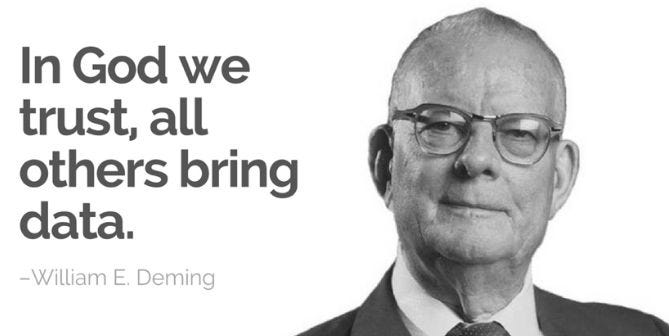
There may be a few other things that fall into that bucket, but you should not have a lot of beliefs like this in life. On the contrary, you should have REASONS why you believe things are true or false. Those reasons should be, at least to some extent, VERIFIABLE.
If I really believe an apple a day keeps the doctor away to such an extent that I don’t bother to get healthcare, then I get sick and have to go to the doctor, it should make me reevaluate my belief.
If you believe most southerners are racists dating their cousins, but you meet a hundred southerners, and none of them are like that, it should cause you to reevaluate your belief. If you believe feminists hate men, and you keep meeting feminist after feminist who loves men (I mean, you won’t, but let’s say you did), it should cause you to shift your thinking.
If you don’t know what would make you change your mind, or worse yet, nothing would make you change your mind, then you have something much more akin to a religious belief than a logical belief. That makes you a prime candidate to be deceived by people playing to your prejudices.
Just assume NOTHING is the truth you see or hear from the "media" and you will be ahead of the game.
Well said!