

People have always wanted to be famous, but the difference between fame today and fame in past generations is that it theoretically seems much more accessible now. The world’s full of Instagram models, YouTube Influencers, Twitch Streamers, TikTok video makers, and X accounts with hundreds of thousands or even millions of followers.
Even if most of the world doesn’t know who you are, to a slice of the world, you can be a rockstar. Being John Wayne, Elvis Presley, or Mickey Mantle was hard. Compare that to PewDiePie, who is admittedly talented, but built an enormous following chatting while he played video games, or the Hawk Tuah girl, who became famous for making a blowjob joke:
Everyone feels like they’re one viral moment away from being famous… and who wouldn’t want to be famous, right?
Fame is one of the most sought-after things in modern American society because it means recognition, attention, money, being swamped by the opposite sex, and being treated as “special.”
Sounds good, right?
Well, mostly.
Why?
Well, for one thing, fame may SEEM TO BE more easily accessible than it used to be, but because of that and the fact that fame is so desired, there are now a staggering number of competitors:
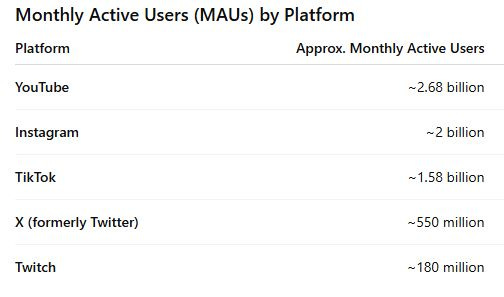
Granted, you don’t have to go that route to get famous, but it’s a lot harder to become Chris Hemsworth, Elon Musk, Sydney Sweeney, Lady Gaga, Donald Trump, or Shaquille O’Neal than it is to potentially get a million online followers. One requires dedicating yourself to a long-shot career and working endlessly with the odds that you’ll succeed being heavily against you, and the other requires… well, what does it require exactly?
Certainly, some of these people have a lot of talent and put in a tremendous amount of work.
For example, I think Jake and Logan Paul (or at least the people around them) have an Einstein-level of genius when it comes to doing things that grab your attention:
The Paul brothers are smart, good-looking, athletic, and as good as it gets when it comes to making you look. That’s why they’ve been able to cut through the noise and become huge names.
However, most people who want to be famous don’t have all those gifts, so how do they get attention?
With wild displays of emotion, outrage, destructive behavior, conspiracy theories, and by being shameless or sociopathic enough to do things other people aren’t willing to do.
PT Barnum’s famous old quote is perfectly designed for the age of social media:
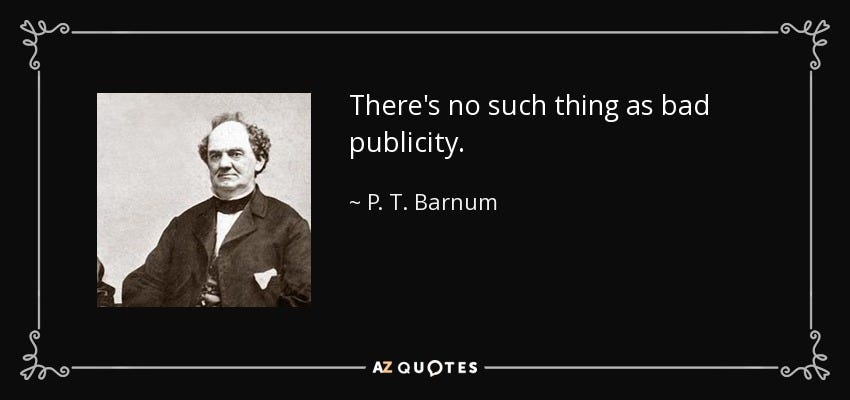
When it comes to fame in the modern era, it doesn’t matter if the traffic is because people love you or hate you, because you’re saintly or vile, or because you tell the truth or you’re a liar; all that matters is that people are willing to watch you.
If you get those eyeballs, it translates into attention, money, earned media, and fame.
But of course, you have to keep the audience looking at you and not the newest shiny object that comes along – and there are always shiny new objects coming along.
How?
Well, by giving them what they want for one. Even if it gets boring to you. Even if you have doubts. Even if you know it’s a lie.
Can Alex Jones abandon conspiracies? Could Shaun King be fair to white people? Could Bonnie Blue be wholesome?
No.
Because they already have audiences, and that’s not what their audiences want.
But even that isn’t enough. If you want to have eyeballs on you, you have to keep making them look over and over and over again.
Maybe that’s by having your child turn trans. By saying something horrible. By creating imaginary drama. By getting naked and doing sexually provocative things. By making inflammatory statements designed to get people to hate each other.
Most famous people may not literally sell their souls to become famous, but figuratively?
Oh yeah. Many of them are as morally compromised as gangsters.
It’s female talent going down on some producer in his hotel room to get on air, political commentators saying something they know damn well isn’t true because people want to hear it right now, it’s selling satanic sneakers to entice millions of Christians to mention your name while they complain about what you’re doing:


What is fame worth? Pretty clearly a lot.
But is it worth your honor? Is it worth your human decency? Is it worth being able to look at yourself in the mirror every night and feel good about yourself as a human being? Sociopaths and narcissists would unhesitatingly say, “Yes, it’s worth it,” but if you’re not broken in the same way they are, you have to question whether they’re right.
Especially since one day, after all the things you’ve done, your show will get cancelled, your album will bomb, or you won’t be able to keep up the blistering pace, so you’ll get stale, and your audience will move somewhere else.
When that happens, you will find out 99% of people never really cared at all.
You may have felt like the center of their universe, but you were actually just a passing fancy to them. A mildly entertaining distraction. Someone they treated like a big deal because other people also seemed to treat you like a big deal.
The graveyards are full of genuine megastars who died, had people say, “Oh no… I liked his music” or “He was a good actor” before they finished their sandwich at lunch and spent the rest of the day laughing at cat videos on YouTube.
Fame didn’t even make a lot of these people happy. Famous people who were only able to cope with drugs and died of overdoses or committed suicide are legion.
Marilyn Monroe. John Belushi. Kurt Cobain. Anthony Bourdain. Ernest Hemingway. Sylvia Plath. Chris Benoit. Dana Plato. Michael Hutchence. Margot Kidder. Hunter Thompson. Junior Seau. Don Cornelius. Robin Williams. This list could go on and on – yet, you have to wonder what would have happened if these celebrities, along with the rest of them, had grown up in some alternate universe where they worked a normal job, got married, had a couple of kids, and lived an utterly unremarkable life.
What percentage of them would have liked their lives better if that’s how it played out for them? It’s probably not a small percentage. Of course, it’s impossible to say, but it wouldn’t be shocking if even a majority of them had happier lives.
So, if someone ever asks you, “Would you want to be famous?” Maybe the best response would be, “That depends on what I’d have to give up to get it.”
Being an inveterate introvert and not a narcissist the last thing I'd ever want to be is famous. If for some reason I gained notoriety, not by evil means, I'm sure I would misuse it and be miserable. I'm happy, truly happy being a nobody.
The attention economy replaced the information economy that replaced the production economy. We only need to get back to the production economy to fix what is messed up.
I have a recent related story. About 3 years ago I concluded a group leadership book club facilitated by a dear friend that runs a company that does that sort of thing. This is a guy that does joint gigs with Tony Robbins.
At that time of this book club thing, I had been a corporate executive for almost 30 years and had attended hundreds of sessions, and read hundreds of books, on modern leadership theory. In fact, my friend that owns the leadership company was hired by me in his twenties, and he today claims I am his primary mentor... which I quickly thank him for but tell him that I knew I would probably work for him one day. And surprise, he is also the chairman of the board of directors for the non-profit corporation that I head.
One of the participants was a young man working in a role as a level-one supervisor of a few other people, and he was required by his management to attend these book events. He was negative, apathetic and cynical and continually took the path of "why does it matter?" and "commitment to any traditional employer and career is useless because they can toss you at any time". I was very intrigued with this mindset as I have a number of young employees, and my core interest has always been human behavior and motivation theory. This young man was quiet, and I would often ask him for his opinion during the Zoom sessions (I was the senior participant... the facilitator was a super sweet and young administrative type that had been trained to keep the conversation going)... I wanted to understand him better... he was an enigma to me.
After hearing enough from him over the several weeks of the club, after reading and discussing several leadership level books with the group, I came to the conclusion that he had been captured by the attention economy... video games and video entertainment... and was frankly bored with his administrative job after being bored with school and landed him the degree that got him the administrative job. His dream job was being a YouTuber.
I mentioned to the group some studies about job and life satisfaction and how, for most people, being creative and working with our hands AND mind is likely an evolutionary need to supply our mental and psychological health. I suggested to this young man that he considered having a hobby where he could be creative if his job did not provide enough of an outlet but also consider changing his job to something that gave him more creative discretion and less "following protocol and checklists". I saw this young man Friday evening at a celebration event for my friend... and he remembered me and told me that he eventually ended up doing what I had advised. He left his public sector administrative job, and went to work for a startup making a real product. He also started his own YouTube channel and was doing podcasts with a friend. But he also built a woodshop in his garage and started doing woodworking products for his home and for friends and family. He even made a custom table for someone that paid him for it. He thanked me for giving him that advice. I told him that I was happy he was in a better place, as he was a bit negative back then.
This gets me to my point. We used to be a nation where the ingredients and rewards for a good life had us inventing, creating, making, building, fixing and selling real tangible products that we would make with our hands and minds. As everything has been digitized while we have exported all of those jobs to other countries for more corporate profit and Wall Street returns... and imported other cheap labor to do that actual productive work... I believe that our psychological health has crashed. Our psychology has not yet had time to evolve to live in the high-tech world we have invented for ourselves. We are growing more apathetic, cynical and depressed because we just don't have enough real productive things to do.
I keep thinking about how we might save the nation if more young people could be provided a plot of land with a goat cheese farm operation. They would heal their broken psychology and I fucking love goat cheese.