

The biggest scandal of the blogger era in the media was “Rathergate.”
It featured CBS’s iconic news anchor, Dan Rather, running a story that made it look like George Bush got preferential treatment in the U.S. National Guard.
The problem was that the whole story was based on an “unimpeachable” anonymous source providing documents that bloggers later proved were fraudulent. Later, the source was revealed to be Bill Burkett, a guy with a history of making accusations against George Bush, who lied about where he got the documents and never really gave a good explanation of how he got them.
The fallout of that story was enormous. It destroyed Dan Rather’s career and did significant damage to CBS News’s reputation for years.
This was an enormous story at the time that helped legitimize bloggers and genuinely made people question the mainstream media.
Do you know what a story like this is today?
It’s just another Tuesday.
By that, I mean stories this egregiously wrong are pushed every week as podcasters, streamers, and mainstream media organizations run stories based on anonymous or sketchy sources that are later proven false.
What are the consequences of that?
Pretty much nothing.
True? Untrue? Right? Wrong? It just doesn’t matter anymore to a large part of the population, probably even the majority of people.
In fact, we could take it further by noting that truth is a COMPETITIVE DISADVANTAGE in modern media.
Why?
Well, there are many reasons for it.
For one, as Margaret Thatcher said:
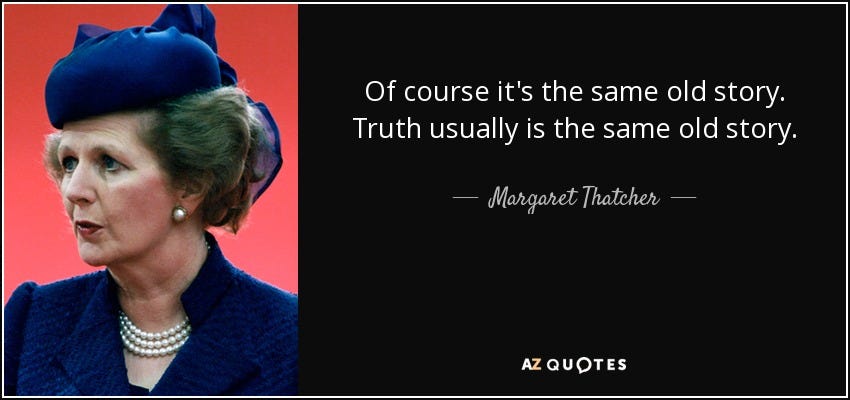
The truth is usually boring because the truth is the same old things you’ve been hearing your whole life.
“Don’t do cocaine” is boring. “Cocaine is actually good for you and an even better weight loss tool than Semaglutide” is exciting. “Democrat edges out Republican in close race” is boring because you already know what happened. “Inside the explosive fraud that our expert says may have cost the Republican the race” gets your blood pumping. “Scientific study raises possible concerns about raisins that we’ll need two decades to fully confirm” is dull as dishwater. “CONFIRMED: Scientific study finds this nutrient in raisins TRIPLES THE CHANCES your gallbladder will EXPLODE” makes you want to click right now to see if you can ever risk eating raisins again.
Of course, if there were a big penalty for misleading people, news sources wouldn’t do it, but there’s not. Do you know what the penalty is for getting it wrong at a big news organization? Most of the time, it’s NOTHING. Worse yet, on social media, the controversy may actually INCREASE YOUR FOLLOWERS.
Similarly, if you’re wondering how so many people who spend all their time making up conspiracies or saying the most inflammatory things imaginable seem to be thriving on the Internet, it works like this:
1) Some big account says, “The Illuminati knocked down the Twin Towers” or “Nobody has seen Donald Trump for two days. That must mean he’s dead!”
2) Enormous numbers of people comment on both sides, “You’re a liar and an idiot,” or “No, they’re telling the truth, and Trump sucks!”
3) The social media algorithms go, “Oh wow, this post is really getting people engaged! Let’s funnel massive numbers of people to it and really juice the reach of the person that put out the post!”
To algorithms on these social media sites, the truth is nothing and engagement is EVERYTHING because engagement keeps you on their site longer, and the longer you’re on their site, the more they get paid.
Furthermore, you have to understand that the news business has changed significantly over the last 25 years. At the start of the period, the prevailing thinking was, “Our reputation is everything, and it’s important for us to at least APPEAR TO BE unbiased because we need as many customers as possible from both sides of the aisle.”
Overtly partisan bloggers and websites started to change that thinking, and eventually, almost everyone fell into a niche of some sort. Popular streamers Hasan Piker and Asmongold probably don’t have a lot of crossover in their audiences. The health influencer who gets famous for being a vegetarian isn’t going to talk up meat, and the carnivore influencer isn’t going to share a study showing vegetables are good for you. The guy whose account is all about dunking on libs isn’t going to tell you he agrees with something Elizabeth Warren just said. The New York Times is never going to run an article telling their readers what an amazing job Donald Trump is doing as president.
Why?
Because “news” has become just another form of entertainment, and when people are being entertained, they like to be told they were right and hear things they agree with. Women aren’t watching a romantic movie to see the heroine they identify with end up alone and bitter with cats in the end. James Bond fans don’t want to see him recast as a black, asexual woman in a wheelchair who cares deeply about trans issues. People want you to repeat back to them what they already believe in a clever and fun way.
This is really what most of the “news” is today, and this may dismay some people, but the most entertaining, over-the-top, emotionally unstable influencers that people love to watch because you never know what might happen are almost NEVER going to the most honest, truthful sources of news. Like a lot of people, I’m a big fan of Joe Rogan and think he does a lot of fascinating, worthwhile interviews, but he also spends a lot of time floating insane conspiracy theories about everything under the sun:
Furthermore, as Mark Twain said:
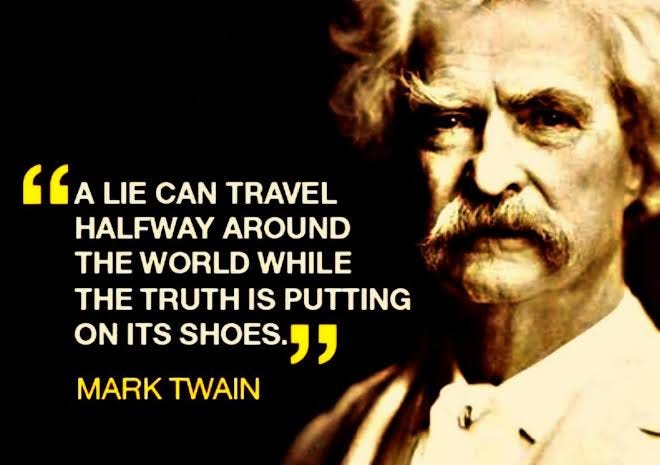
That becomes a particular problem today because the big lie in the headline gets ENORMOUS ATTENTION, but the “Oopsy, that was wrong” story often only gets out to a fraction of the same audience.
Furthermore, these lies may be repeated over and over for years or even decades and portrayed with links back to the original lies in a partisan media environment where lies about people on the other side seldom get corrected.
The “Very Fine People” hoax is a great example of this:
Trump made his original comments that were taken out of context in 2017, and Joe Biden was STILL LYING ABOUT IT in August of 2024, at the Democratic National Convention. Why wouldn’t he? It’s not as if liberal media sources were going out of their way to correct lies about Trump, so many people on his side who heard those comments hadn’t been exposed to the truth from anyone other than conservatives who they refused to believe by default:
Lying about that is EASY. Explaining the truth usually requires getting a liberal to listen to a non-liberal source because left-wing sources won’t address it, getting them to look at a longer clip, and convincing them that someone they hate, despise, and don’t want to defend is right while the people they’ve been holding up as heroes and truth tellers are lying to them.
It’s a long, uphill slog at every stage of the game.
How do we get back to the media caring about at least APPEARING HONEST again? It all has to revolve around punishing liars in the media, and the next step from there is SOMEHOW creating news sources both sides trust.
Until that happens? Search for news sources that care about getting it right and take everything you hear with a grain of salt.
The irrelevance of "truth" in modern America is a subject to which I have devoted considerable thought in my personal and political life and in my professional life as a lawyer. Hawkins, by reminding me of Rathergate, has punched one of my buttons. and I simply have to sound off...in support of what he said.
There are 3 phenomena I have noticed in personal life that, to me, indicate that Hawkins is on the money when he says that truth is a competitive disadvantage in our society.
These are subtle changes in mass behavior and speech that possibly are hallmarks of fundamental shifts in subconscious thinking.....perhaps showing that on a subconscious level people have a dim awareness that something is wrong, something has changed, and not for the better.
"THIS IS A FREE COUNTRY, ISN'T IT?"
and "YOURE A LIAR":
When I was a child, I used to here the phrase repeated fairly commonly, "It's a free country, isn't it?"
This was usually said when someone tried to unreasonably control someone else's behavior or speech.
I haven't heard anyone say "It's a free country, isn't it" in a very long time. I would like to believe that this reflects a subconscious recognition by the herd at large that this is NOT a free country any more.
Likewise, along the lines of what Hawkins says here, it was a big deal when I was a kid if some kid said to another kid, "You're a liar" or "That's a lie."
Such a statement often led to a fist fight. A thoughtful kid was careful about accusing another kid of being a liar.
It was an important thing to us kids that we not be thought of as liars but as guys who spoke the truth.
Nowadays, such remarks don't seem to matter. They don't provoke much response.
Conversation just moves on. Nothing of note here.
I suspect the lack of response indicates the fact that it doesn't really matter any more whether someone is lying. Lying is so common, so socially acceptable, that an accusation along these lines is just shrugged off....not important enough to warrant notice.
"I DON'T NEED THIS!"
There's a new phrase that has come into use in our language:
"I don't need this."
One might ask, what does this phrase have to do about the status of truth in our society?
Well, IMO it has quite a lot to do with the status of truth in our society.
Right off the bat, someone who says, "I don't need this", has relegated TRUTH to a subordinate position.
By saying "I don't need this" the speaker has made his position clear - the question is not whether the statement us true. The critical thing has become how he FEELS about the statement.
Saying "I don't need this" becomes a clever way of halting consideration of whether the statement that has provoked the person who asserts that he doesn't need it is true or not.
Scrutiny has been moved from truth to the subjective and often petty emotions of the one who "doesn't need this."
Truth no longer matters. How he feels trumps the issue of truth.
It's an important matter, a slight of hand, that we ought to take note of.
To me, the fact that the offended person will not deal with the facts of the matter face on, but chooses instead to make his own vanity the subject means in 99 cases out of a 100 that what was said is true.
And, from my experience, in all cases in which someone tries to block consideration of truth by objecting that he doesn't need this, in fact he does need it. He needs to think about it, engage in some moral introspection and amend his ways.
"I don't need this" shares something with the statement "He thinks he's better than me."
Invariably, the statement "He thinks he's better than me" means that the person in question is in fact better than the huffy, "insulted" person.
I doubt that the late Queen Elizabeth in her entire life said of someone employed in the kitchen, garden or stables of one of her palaces, "He thinks he's better than me." I don't think the Queen ever said this about anyone at all. She knew at all times that she was better than others so the haughty behavior of others never impacted her sense of self worth. At heart, she didn't give a damn what they thought.
But I digress and should return to the subject.
"THIS IS INSENSITIVE."
Moving on to something that will especially please Hawkins:
Have most of you noticed how use of the word "insensitive" has exploded in our times?
Liberals LOVE the word insensitive.
They regard it as magic.
As with the statement "I don't need this", employing the word "insensitive" immediately and trickily shifts the focus from whether the statement is true onto whether it isn't sensitive to the emotions of some member of one of the Regime Support Groups (my semantic invention) who are special and who must never be offended.
By saying "John Doe's remarks on this subject are insensitive", it's usually intended (and it works!) to ring down the curtain, stop confronting and dealing with the truth of what was said and to shift the subject to the supposed entitlement of the specific Regime Support Group in question (Jews, Blacks, Hispanics, illegal aliens, American Indians, Asians, homosexuals, the transgendered, the handicapped, the noble "street people" (or as we much now call them "the unhoused"), women....you all know who the Special People are and you could probably add more Regime Support Groups to this list) to an immunity from criticism.
I have never heard anyone except an ideological liberal, a self-righteous, conniving, sneaky liberal at that, use the word "insensitive" in this manner. By declaring that the remarks are "insensitive" a liberal can avoid dealing with unpleasant facts that intrude upon his fantasy world....irrefutable facts like the fact that Jewish members of Congress who are "dual citizens" of both Israel and the United States clearly have divided loyalties, the fact that a Black is over 20 times more likely to kill or rape a White person than a White person is likely to kill or rape a Black person, the fact that Biden's illegal admission of 25 million aliens is the most important factor in raising rent and housing costs, the fact that homosexual sex acts are intrinsically dangerous and potentially fatal, the fact that the unhoused are the bottom drawer of human society, the fact that men make better soldiers than women.
Here again is evidence that truth doesn't matter.
These are low level, day to day, speculative semantic indications that truth no longer matters.
They lend some collateral support to Hawkins' idea that truth puts you at a competitive disadvantage in a profoundly sick culture and society like we "enjoy" in modern America.
Hawkins understates his case.
Truth not only is a competitive disadvantage. Truth is far more disgusting and repellent than that.
The "truth of the matter: is that to modern Americans in general and to liberals in particular, truth is repellent and disgusting.
Truth is racist, homophobic, xenophobic, Islamophobic, antisemitic, male chauvinist...as well, of course, invariaably being "far right", "fascist" and "White supremacist."