

It’s not really Generation Z’s fault that they’re the softest generation in all of human history.
Many of them spent their whole life in front of computers with their parents hovering in the background, being told that they needed to be shielded from opinions they don’t like and that they’re victims because they have to deal with normal human struggles.
Then, when they got to adulthood, many of them were terrified because they’d never really been prepared to be an adult because mom and dad (or in many cases, just mom) were around to do everything for them.
So, to a lot of these kids, the idea of getting out on their own and being responsible for their own life is frightening.
That, not economics, is really the biggest reason that this is happening:

How are you ready to get married, be an asset to society, or even call yourself a real adult if you can’t cut it without living with mom and dad?
If you point this out, you get fed a flood of self-pitying nonsense about how it’s tougher than ever for Gen Z. If you note that every generation has struggles and it’s really not tougher than ever, the response is usually something akin to, “Okay Boomer,” as if that’s supposed to be some sort of devastating comeback.
Setting aside the fact that there are lots of people that aren’t Boomers pointing out Gen Z doesn’t have it uniquely badly and that just noting someone is a Boomer doesn’t automatically mean they’re wrong, what challenge has Gen Z faced that’s as tough as the one the Boomers dealt with during the Vietnam War?
Oh, that’s right. Nothing. Nothing even close.
Still, I want to be fair about this. So, let me address the biggest complaints I hear from Generation Z that supposedly explain why they have it so tough.
The first is housing.
There is no question that the cost of housing has gone up significantly since COVID and the market isn’t turning over very fast right now because of high interest rates. So, if the standard is, “Are houses cheap right now?” then the answer is, “No.”
However, houses are also not extraordinarily expensive either compared to historical rates. In fact, the cost per square foot of a home hasn’t gone up much since the 1970s. On the other hand, what has gone up dramatically since then is how much space each person thinks they need in a home:
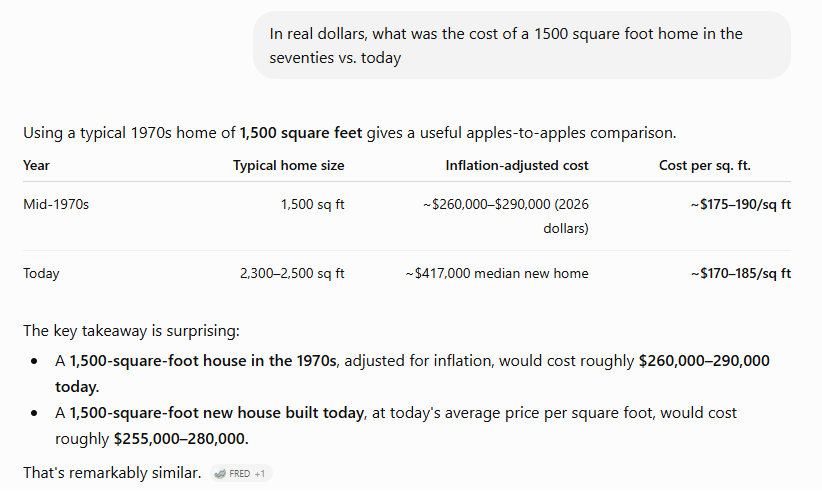
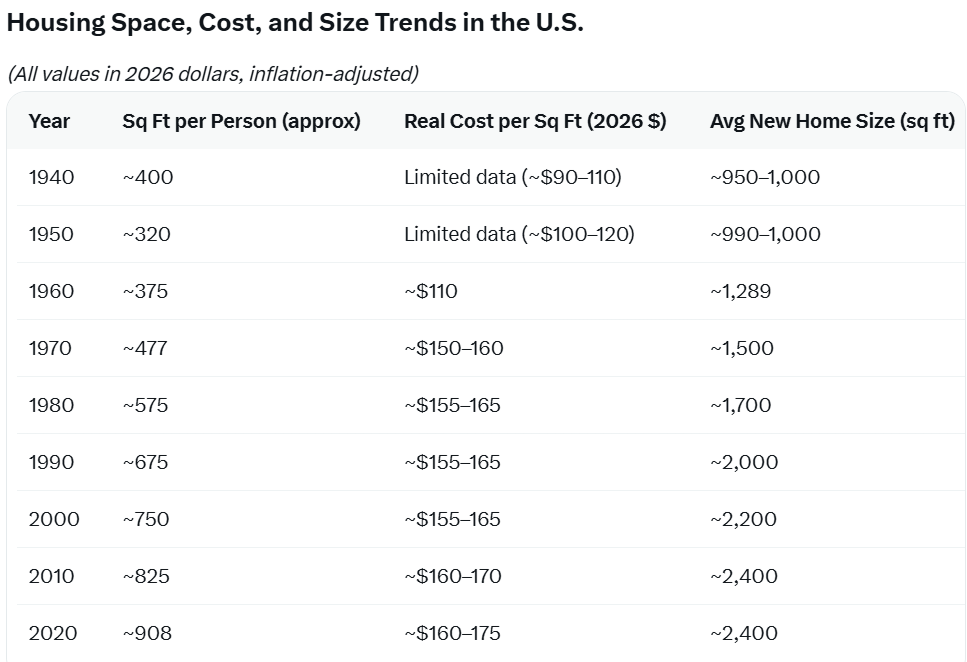
If you say, “I still can’t afford a house! I’d have to get roommates!” Well, join the club. There’s nothing new about that. I had roommates. Most of my friends had roommates. That has been a standard thing for decades for many people in their twenties.
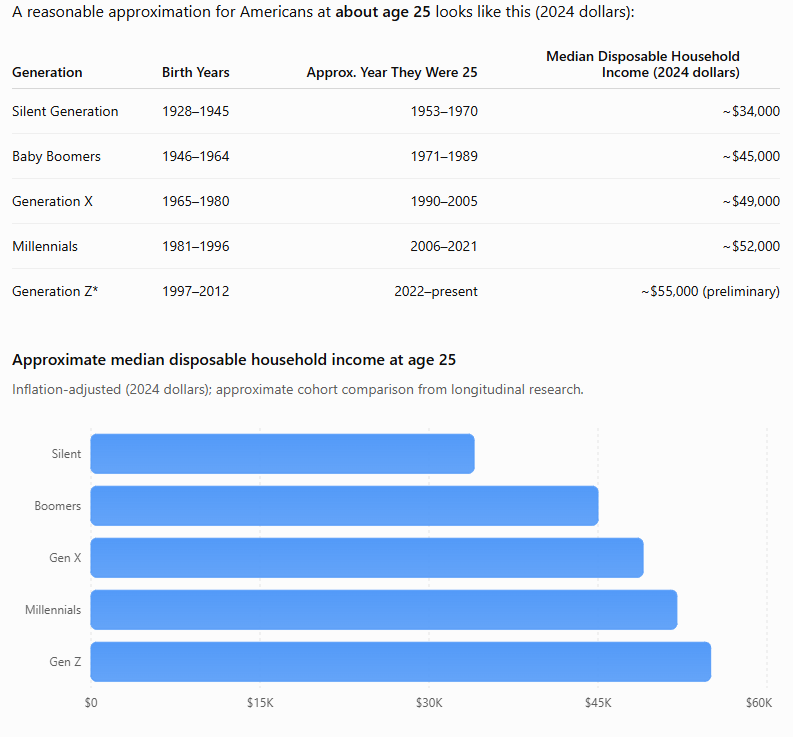
The other claim is that everything is so expensive now that they can’t possibly afford it. Again, it’s true that since COVID we certainly had a big burst of inflation caused by the FED dramatically increasing the money supply. But if you compare apples to apples, Gen Z is doing better than any generation that came before them in disposable income:
However, you know where Gen Z is not doing fine? In their expectations. Perhaps it’s not a surprise that people who grew up looking at influencers flexing their wealth on social media have skewed expectations about what a “necessity” is and what you need to make it, but this seems a little bit on a loopy side:
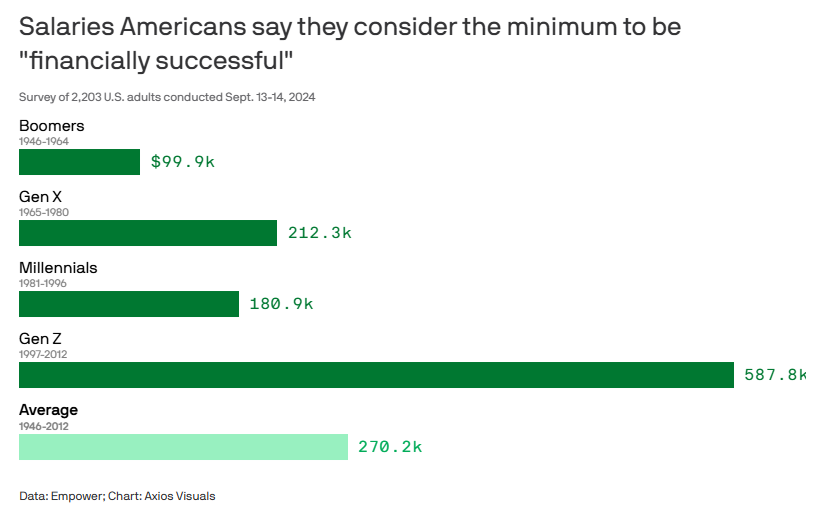
By the way, if you’re wondering what percentage of Americans earn $587.8k or more in a given year (it’s worth noting that doesn’t mean EVERY year, it means in any given year), it’s about .5% of the population. So, roughly 99.5% of Generation Z is destined to be a financial failure by their own standards.
Does the fact that Generation Z is the most sheltered generation in history play into these extreme ideas about what it takes to be financially successful?
I’m sure it does – and that ties into the whole reason you should kick your kids out of the house when they turn 18.
The job of a parent is to turn their kids into functional, capable adults. If they’re living at home, mom’s doing their laundry, dad’s buying them dinner and they’re lying on the couch, playing a video game for hours a day, they’re not adults in any meaningful sense. They’re still children. How long are you going to extend your child’s adolescence? To 22? 25? 30? At what point should you tell your child, “It’s time to leave the nest and go out on your own?”
Don’t get me wrong, I’m not saying you shouldn’t help your kids. I was still driving a beater my parents bought me when I was in high school, long after I left the house and they paid for my college. So, they did a LOT for me.
But there was also never a question whether I was going to be leaving at 18 on their part or mine. I would have been DEEPLY ASHAMED if I had to go back home and mooch off my parents. So, I took crap jobs. I had roommates. Let me also note that none of that makes me exceptional in any way. It was just normal and expected that things would be that way both for my friends and me.
It’s also true that I, and a lot of my friends, struggled a good bit. Some people don’t like the idea of their kids struggling, but struggle gets a bad rap. It’s making it through the struggle that helps you make better decisions in the future, gives you resilience, and teaches you that you can handle tough situations. It’s something that all adults need to learn to do if they’re going to be successful in life. Allowing them to boot that down the road to their mid-twenties or later probably isn’t going to help their development as a human being.
That being said, don’t get me wrong. If you want to set up some kind of deal with your kids where they pay rent for a little while or work their behinds off and build a nest egg by living with you for a few months, that makes perfect sense. You’re doing your part to help your kid get ahead, not keeping baby bird under your wing.
However, many Americans are clearly going far beyond that and allowing their kids to extend their childhood into their mid-twenties (or even later) on mom and dad’s dime. That’s not good for mom and dad, or even their kids, who need to grow up and start acting like adults. There were ancient Roman boys marrying at 14 and American soldiers fighting in the Civil War at 15. Surely, if your kid is really an adult, they should be able to start making their way in the world at 18, as so many hundreds of millions of adults before them have done through the years.
Great piece, John. Thanks for putting together the data that demolishes the story line that today’s kids have it so much worse. The follow up to this is that expecting to earn more than a half a million dollars a year after graduating with one of the many useless degrees offered by one of the failing “elite” schools which has resulted in severe disappointment and misery, which make socialism seem like the only answer.
Way back when (1961) my high school had a class called Senior Problems. It covered basics like economics of work, taxes, marriage etc. Seems now that 12th grade was a bit late for such subjects. I wonder if any public schools still require anything like it. (Guessing not.)