

Have you ever heard of “love languages?” Gary Chapman came up with them in 1992, and they were a revolutionary concept in relationships. The idea behind them is that different people prefer to be loved in different ways.
There are words of affirmation, quality time, acts of service, physical touch, and receiving gifts. Granted, most of us enjoy experiencing love in all of these ways to some extent, but there are usually some that we like better than others.
This can be very important in a relationship because if you hang on to your boyfriend all the time because YOU enjoy physical touch but never give him any compliments because that doesn’t matter to you, he may not feel all that appreciated because he cares most about words of affirmation. On the other hand, you may be giving your girl flowers, and she seems indifferent to it, because she’s all about quality time, and you’ve been super busy the last couple of weeks and have barely seen her.
Interesting, right?
Well, grief is a little like this, too. Different people grieve in different ways, for different lengths of time, and at different levels of intensity. I still remember a woman I knew telling me she cried after my dog died because she knew I wouldn’t do it – and I didn’t. That doesn’t mean that it didn’t hurt or that I didn’t grieve. I just didn’t grieve the same way that she did.
That brings us to a story that initially came from Reddit:

You know it’s easy to talk about different styles of grieving. Some people get depressed. Others try to distract themselves. There are also people who isolate themselves or try to put on a brave front in public, even if they’re crushed in private.
We could also talk about the five famous stages of grief:
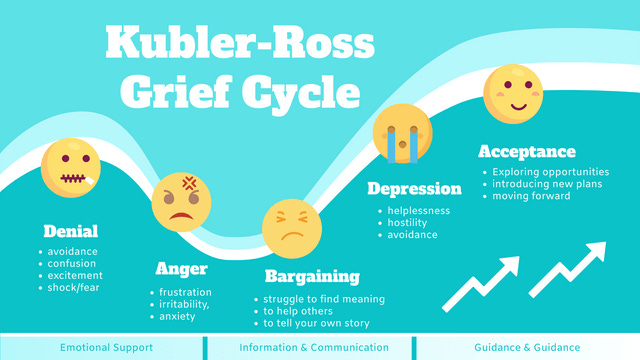
At the end of the day, it all usually seems to come down to the fact that we only have so many people we deeply care about and rely on, and when one of them dies, it hits hard.
Personally, I’ve put down two of my dogs (Patton and Jackson). Furthermore, both of my grandparents have passed, and most recently, my father died within a couple of weeks of Christmas 2021. There was nothing easy about any of those deaths for me. They were all important to me, and I grieved for all of them. (It’s a little unfair to put the dogs in there with the people, but when you come home to an animal for years at a time, and you are its whole world, it creates a bond. Animals are not as important as people, but they’re on your team, just like the people you care about.)
Still, I didn’t grieve forever. It was like the famous line from the 16th-century Scottish ballad, Sir Andrew Barton:
“I am hurt, but I am not slain;
I’ll lay me down and bleed a-while,
And then I’ll rise and fight again.”
Sometimes, you can be functional, seem okay, but still be bleeding. To this day, I miss all of them and would love to see and talk to the people again or pet the little heads of my dogs, even though I know it’s never happening again on this side of the veil.
There are two reasons people ultimately tend to get trapped in grief like the woman in the story and are unable to pull out of it.
The first is that some people tend to think that the more depression they feel and the longer it lasts, the more they’re showing their love for the person who was lost. To them, it can almost feel like it’s as if they didn’t love the person that was lost, or that it’s disrespectful to them if they aren’t grieving heavily for a long time.
However, think about that for a second. Would you want someone you cared about deeply to suffer because of you? Granted, it might be nice if they showed SOME EMOTION after you died, but how long do you want that to go on? Do you want them sitting around a year later, feeling bad about life because you’re dead, or do you want them to be happy again? Maybe it’s because I come from a family that doesn’t believe in having funerals (my dad didn’t have one, my mom doesn’t want one, and neither do I), but I wouldn’t ever want someone who meant something to me to be miserable because of me. Have a good cry if you want, but after I’m gone, let me go and have a good life again.
So, you might say, “Okay, that’s easy for you to say, but how did you get past losing these people who meant so much in your life?”
In a word, gratitude.
I was able to move on from aching over the fact that they’re lost to me to being grateful that I had them in my life. The sad truth is that nothing is forever, my friend. Every love, every relationship, every deep friendship and family tie – one way or the other, it’s ALWAYS going to be temporary. Relationships fail. Friendships fade. People you love die.
It is what it is, but how do you interpret it?
Do you sit around, permanently marinating in how much you miss someone and what a hole it’s going to leave in your life? It’s no surprise that you’re depressed if you do that because it’s a depressing way to look at it. What you should do is remember that it’s all temporary and be grateful for the time you had with them. So many people are estranged from their parents, don’t have a great marriage, never have a chance to be close with a sibling, or even have a close friend. If that’s not you, that’s something to celebrate and be grateful for instead of turning it into something that makes you miserable.
So yes, to answer the question posed in the title, three years is too long to grieve. If you need to read a book or go to a therapist to get over it, do it, but don’t allow yourself to lie down and bleed forever. It’s not good, it’s not natural, and it’s not healthy for you or the people around you.
That reddit story of the wife isn't grieving, it is vulnerable narcissism... moving close to demonstrating a dark triad personality disorder.
No, nope, never, not on my watch.
The husband is responsible for enabling. I'm sorry, but life... that too short period of time... that four twenties and some change if we are lucky... is a repeating cycle of periods of relative calm between the next crisis or tragedy. There is absolutely ZERO justification for anyone grieving about some loss to force their emotional pain onto other family members. Yes, empathy dictates moving the line of acceptable behavior lower for some time, but that clock should be very short. Because every day spent wallowing in grief wastes a precious day in preparation for the next life milestone of new grief.
I have seen this play over and over again destroying marriages. My brother In-law did the same. His father in-law had ALS and eventually died. His wife milked that situation for control. She would rage at him for not following her orders, and then when he would call her on it, she would shrink into a crying victim and he would of course run to comfort her because he was a good guy. Then he would accept her orders to prevent the crying. They divorced.
I told him that he needed to draw the line. That many females have a chronic bipolar problem... uncontrolled emotions and swing to extremes of rage, sadness and euphoria. Without boundaries set they will eventually light fire to every relationship.
"Hey honey, I love you and am sorry for the pain you are going through over the loss of your dad. However, your grief should not negatively impact your other relationships, but it has been. Let's work together to get passed this so we can better enjoy the good days we have until the next crisis or tragedy. I promise to work as hard as I can to make things better, but I need the same commitment from you. I will provide gentle reminders when you are having a bad day that we need to make sure it does not negatively impact our relationship and the relationship with our children."
And then if the gentle reminders don't work, get direct. Draw the line. Don't be an asshole. Don't be mean. Just be calm and consistent but firm.
People definitely grieve differently. However, some people cross the line to the point that they are making it about themselves. The woman in the story, though, sounds like it might be a molestation situation. That is unnatural (3 years I mean).