

It’s no secret that housing has been getting more expensive in America. Granted, it may not be as expensive as people think because some of the ways the data is presented are a bit deceptive. Still, one of the most accurate, reasonable ways to measure the increase in home prices shows a very large increase in prices:
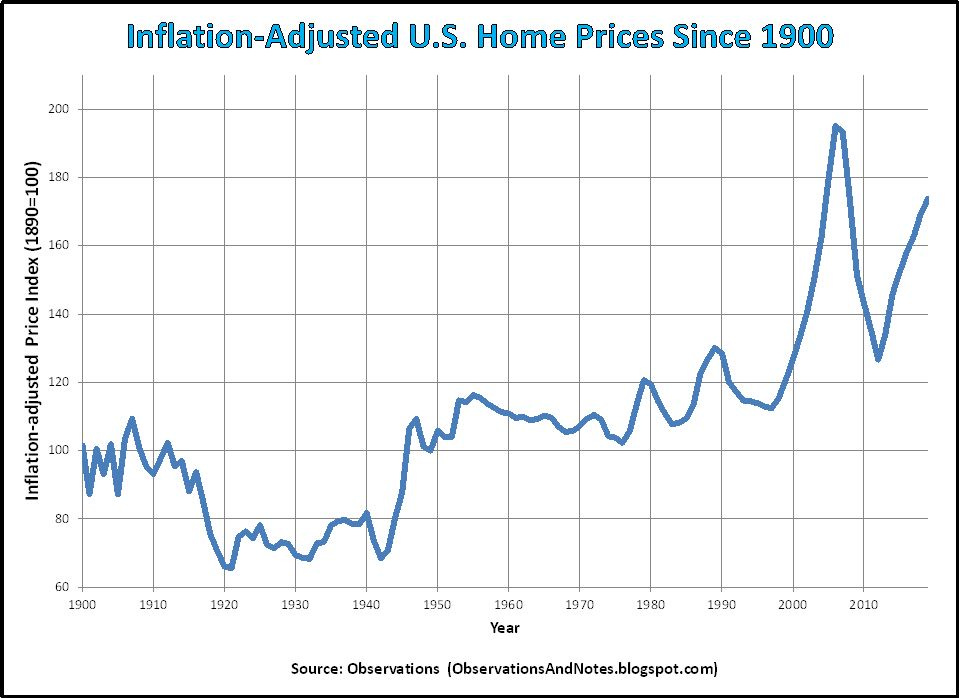
You can’t boil the reasons for this down to a single cause because there are a lot of factors at play.
People want much larger homes with a lot more amenities than they did in past generations. Zoning laws and rent control in some places have made it difficult to build more housing. Our population has gotten more urban and there’s less room to build in the cities. Low interest rates and cheap credit before the COVID inflation spike made it easier for buyers to bid up prices. Construction lagged a bit after the 2008 housing crash and has never quite caught up. Short-term rentals (Airbnb, VRBO) reduced the supply.
It goes on and on.
Some of these factors are easier to address than others. For example, do you want a cheaper house? Then buy a smaller house or one in an area that’s less built out and therefore, has less demand. It’s no shocker that it’s cheaper to buy a home in West Virginia than California.
However, there is one factor that deserves a lot more attention, not just because it’s a significant reason home prices have gone up, but because it has the potential to be a destabilizing factor in our country over the long-term.
That is large corporations and REITS buying extraordinary numbers of single-family homes as an investment. Note that we’re not talking about small time landlords here. They’re not the issue. We’re also not talking about corporations building apartments or large housing complexes. All in all, those things ADD to the housing supply and probably reduce the costs of housing overall.
On the other hand, when you look at the scale on which these massive entities are buying up single family homes and what they’re doing with them, you can start to see how this is a problem:
Investors bought 1 of every 6 U.S. homes that sold — purchasing $43 billion worth of properties — and 1 of every 4 low-priced homes that sold.
...Investor Home Purchases Are Up Almost 30% in San Jose and Las Vegas, Down Over 15% in Fort Lauderdale
In both San Jose, CA and Las Vegas, investor home purchases rose 27% year over year in the second quarter—the biggest jump among the metros Redfin analyzed. Next came three more California metros: Sacramento (18.9%), Los Angeles (17.9%) and San Francisco (17.8%).
San Jose also saw the largest gain in overall home purchases, which rose 15.2% year over year in the second quarter. San Francisco came in second place. The Bay Area’s housing market has been bouncing back after slowing substantially during the pandemic, and investors have reaped hefty gains over the last year.
The typical San Francisco home sold by an investor in June went for $685,500 more than the investor bought it for, up 50.7% from a year earlier. That’s the biggest increase among the metros Redfin analyzed. Next came San Jose, where the median capital gain rose 48.3% to $808,500.
Craig Pellegrini, a Redfin Premier real estate agent in San Jose, said about one-quarter of the buyers he speaks to are investors. Roughly half are institutional investors, and the other half are mom-and-pop investors, he said.
“San Jose has a lot of overseas investors buying sight-unseen, and a lot of home flippers who are purchasing dilapidated homes, putting some lipstick on them, and selling them for a profit,” Pellegrini said. “I’m also seeing parents buy second homes that they plan to rent out for a while and then pass on to their kids, some of whom just graduated from college and can’t afford to buy themselves.”
On the one hand, these investors aren’t doing anything immoral by buying homes en masse. There’s money to be made there by renting them out; they have the capital to buy up a big share of the market, and they’re choosing to do so. It’s understandable, right? But that brings us back to a variation on an old economic concept called “The Tragedy of the Commons”:

As these corporations and REITs pump massive amounts of money into the housing market, they’re raising the cost of homes. Because of their size, they’re also getting loans cheaper than the average person can.
Imagine you’re Jimmy and Jenny Smith, 30-year-olds trying to buy your first starter home, and you have to get a loan at the high rates your bank offers, while you’re competing against BlackRock, a corporation with infinite money that can get loans at a tiny fraction of what you can. We all know who wins that battle and what happens next? The house gets rented out, and instead of paying down on a house they own, Jimmy and Jenny (or some couple like them) pay rent to BlackRock.
Most everybody reading this has heard of the notorious World Economic Forum’s “You’ll Own Nothing and Be Happy” article, and this is EXACTLY the sort of thing they envisioned, something that helps create that scenario over the long-term. They believe many things will get so expensive that corporations and the wealthiest people will own everything and rent it back to the public.
How do you stop this? It gets stopped by Congress doing their job and essentially saying to these big corporations, “You are absolutely welcome to invest in and build more housing, buy apartment complexes, and make a big profit on it. However, we’re going to severely limit the number of single-family homes you can buy.”
This would not be a radical change because Congress has put these sorts of limits on corporations a number of times before. Our government reviews large mergers that have the potential to create a monopoly, it has separated commercial and investment banking, and it has enforced separation between the livestock and meat packing industries. This wouldn’t be that different from any of those, it wouldn’t be punitive, and it would benefit American consumers.
Also, from a conservative perspective, if this trend isn’t checked, it could be a long-term threat to the stability of the United States. Certainly, we’re not there yet, but it’s very easy to see how we could eventually get to the point where the average person can’t afford a house because corporate monoliths have pushed the prices so high that no one but the rich can afford to own anything.
So, let’s fix that problem now before we have people ready to riot in the streets one day because the American dream of home ownership is being denied to them in order to add .25% to the bottom lines of giant corporations.
We do want those corporations to succeed. We want them to make plenty of money so they can provide lots of jobs and taxes, but not at the expense of home ownership for the average American.
I started a business and went to my fairly extensive network of reasonably high-net worth friends and family to invest. I was constantly running into this problem of expected returns from the alternative of real estate.
My other company makes commercial real estate loans to small business. Almost all of these borrowers show at least one rental property on the personal financial statement.
Throughout the history of economic man, owning real estate that returns rental income has been a key source of wealth. I am reading about the Roman empire where wealth and political power of a person were often connected to the real estate holdings of the person.
I remember years ago looking at homes to purchase with my wife when my relator started going on about the equity we would realize from the neighborhood demand. I fired him on the spot and told him that he is not an investment advisor, his only job was to help us find a home that met the needs of our family.
However, I absolutely agree that things have gotten out of hand.
We need capital to flow to reindustrialize the country... for private equity to spur innovation, entrepreneurialism and enterprise... activities that benefit many and not just support selfish returns on investment like real estate.
Thank about it this way... instead of Blackrock buying up all the existing housing inventory, Blackrock should be investing in new housing development projects.
Not only is the trend for big capital snatching up rental properties driving up rents above the rate of inflation, but it is also preventing capital from going where it is most needed.
I'm confused. You accuse these REITs of "hoarding"...but to what purpose? Every day they "hoard" these houses is a day they're losing money better invested elsewhere.
Now of course it's true that if most of these houses are being sold to wealthy and in some cases offshore purchasers, that might hurt some prospective purchasers in this country. But--and here's the part I don't quite get--isn't this just a wholesale version of brokers who specialize in this kind of sale? I mean...if I'm a real-estate broker who wants to make his money by identifying and selling high-value properties to people from abroad who have more money than sense...how is that different than what you describe here?
Don't misunderstand me...I'm not saying you're wrong. I'm just saying I don't really understand why the dynamic you describe is any different from business-as-usual.