

There’s no question that there’s some kind of natural obligation most living things feel toward their family. Many mothers in the animal kingdom will feed their children under the toughest of circumstances and even risk death to protect their babies:
Still, we humans can choose to go beyond whatever biological impulses we feel and make our own choices about how far we go to help our families. But sometimes it’s hard to know where to draw the line.
For example, to most people, this just seems wrong:
Renowned producer and TV personality Simon Cowell recently revealed that he does not plan on passing down his approximately $600 million fortune to his 11-year-old son Eric.
Cowell shared that his wealth will go to charities that support children and dogs instead. “I don’t believe in passing down money from one generation to the next,” he added, clarifying that he intends for his son to achieve success by his own means rather than inherit it.
College will be paid for, and then you’re on your own,” Cowell stated, explaining how his parents empowered him in a similar way and how he plans to carry that legacy forward.
On one hand, it’s his money, and he can do what he wants with it. Furthermore, you can totally understand the fear a celebrity might have of giving their kids too easy a life and turning them into weird, spoiled brats (PS: Here’s a short about Will Smith’s kid Jaden for no reason whatsoever):
On the other hand, when you’re worth the kind of money that Simon Cowell is, just a few crumbs from your table can help your kid buy a house, buy a car, and start a business. You can very easily give your child a significant leg up in life without handing him so much money that it ruins him. Very few people are going to have the sort of money Simon Cowell does, but even a little money can sometimes go a long way toward increasing your child’s trajectory in life. So, why not do it? If you’re not going to be looking out for your kid, who is?
On the other hand, you can see some sort of abuse of expectations taking place in a family. Maybe your family member is a junky or an alcoholic and wants you to enable his terrible behavior, or worse yet, your kid is a monster who’s going to hurt people, and you end up having to take steps to stop him. For example, after he assassinated Charlie Kirk, Tyler Robinson’s parents figured out it was him, and they didn’t try to help him get away with it; they convinced him to surrender:
When she saw the photo of the person suspected of killing political commentator Charlie Kirk, Tyler James Robinson’s mom told police her first thought was that it looked like her son.
She immediately called him to ask where he was, according to charging documents released Tuesday. Robinson reportedly told her that he had been sick at home for the past two days, including the day of the shooting, where a single shot hit and killed Kirk on Sept. 10.
But Robinson’s mom couldn’t shake the similarities between her 22-year-old son’s face and the image released by law enforcement that quickly circulated online, the charging documents state. She told police she also discussed the photo with her husband, who agreed with her.
Increasingly worried, the couple repeatedly called and spoke with Robinson last week until he “implied that he was the shooter,” the documents state. And then, 33 hours after the shooting at Utah Valley University, they convinced their son to turn himself in.
This was not a typical case, in that it was so high profile that Robinson realistically had no chance of getting away with it. Still, his parents did the right thing. You absolutely should take your child’s side, but there also have to be limits to that, or you’ll end up being one of those horrible families defending the indefensible:
The father and son terrorists who opened fire at Bondi Beach had visited the Philippines just weeks before their attack, sparking concerns they were following the path of Islamist extremists.
...Naveed, an unemployed bricklayer, and Sajid, a fruiterer, allegedly opened fire into a crowd gathered to celebrate Hanukkah.
Their rampage left 16 dead and scores injured.
...Akram’s mother was unable to identify her son from a photo from the scene of the shooting but said she didn’t believe he could be involved in any violent or extremist activities.
“He doesn’t have a firearm. He doesn’t even go out. He doesn’t mix around with friends. He doesn’t drink, he doesn’t smoke, he doesn’t go to bad places … he goes to work, he comes home, he goes to exercise, and that’s it,” she told this masthead.
“Anyone would wish to have a son like my son … he’s a good boy.”
Of course, most abuses in family situations don’t get this far out of hand. A more typical example could be something closer to this:
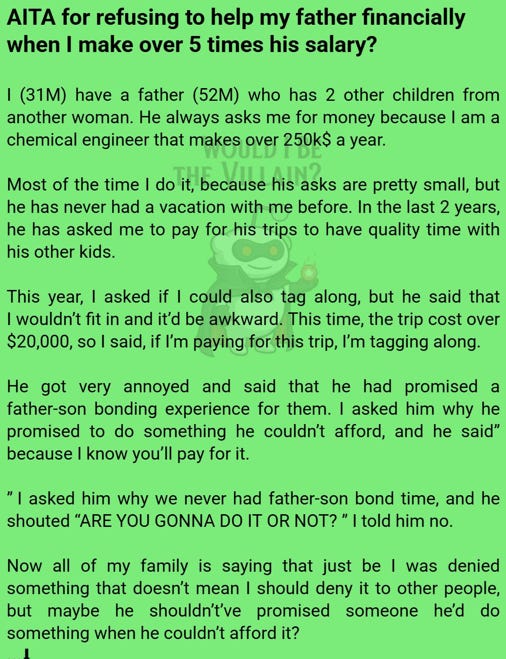
If this is true, it sounds like his father is increasingly taking his son for granted and treating him like a wallet instead of his child. A father should be EMBARASSED to ask his child for money, although, in certain situations, there might still be a reason to do it. Asking your child to pay for vacations or, worse yet, to pay for trips so you can spend time with your other children when they’re not welcome to do the same? It just speaks poorly of his father as a man.
Family can and should forgive a lot, cut each other a lot of breaks, and try to help each other as much as possible, but there are still limits to that. As much as you may love your family, you don’t have an obligation to let them take advantage of you.
When I was young and struggling, my late father helped me pay for repairs to my piece of junk car to keep it running, so I could go to work. If my mother needed help with her bills, which she doesn’t, I would help out. Still, I can’t imagine either of us ever asking the other to pay for their $20,000 vacation.
Not every person sees it like this, but for me, the priority order goes God, family, friends, country, and conservatism. Take care of your family, make them a priority in your life, and do your best to help them. However, there are limits to everything, including how far you should go to help your family.
I have an irresponsible brother. I always try to be generous, but I give money to my brother grudgingly, so he finds it unpleasant to ask, and will try other avenues before he comes to me.
My natural father hit mental health problems in his late 20s and split. My mother, with only a high school education, raised three sons in near poverty but without any public assistance. She remarried to a guy that basically attempted to supplant me as the new oldest son. We fought... fist fights and all. I usually lost because he was big and fat and played football in college. But after high school I split. I had already been working since I was twelve. Paid for my own car, my own clothing... just about everything discretionary. I never got a dime from any family member. Even though the stepfather made a lot of money in his business (and lost it all later).
I have two sons. Both wonderful. Both working for me. One is married with our first grandchild on the way. Ther other is engaged.
But looking back on my life where I have been very successful professionally and make a very good living, I have failed to help other friends and family members, enough I think, because of my perspective connected to my own life were I just solved my own problems and moved forward. I think my sons are great because of my work ethic and pragmatic focus on just putting one foot in front of the other and dealing with each challenge. But I have some regrets that I did not reach out to other family and friends that needed help because I expected them to do the same. Three family suicides haunt me with my own guilt for not having done more to help them.
Helping immediate family is different. There is just this need for practicing the types of behaviors that are positive and are emulated. It also required more tough love at times... ignoring some of the short-term pain of conflict for the greater long-term good. However, when the bonds of love are weaker... extended family and friends... sometimes just giving something can help and is the right thing to do. Not to enable bad behavior and bad choices, but to help people get through a rough patch.