

The United States and Iran had a long, somewhat complicated history before the recent conflict. If you truly want to understand the current war, it helps to at least have a basic understanding of the backstory.
America’s entanglement with Iran really started when they elected a prime minister who soon thereafter nationalized their oil industry, which the British then controlled. We tried to mediate the issue between the countries, but we were closer allies with Britain and soon began to fear that Iran was going to drift toward the Soviet Union’s sphere of influence. During the Cold War, when the United States and the Soviets treated the whole planet like pieces on a chessboard, this drove a lot of our foreign policy decisions. In this case, it prompted us to partner with Britain and help the Shah of Iran, who was already part of the government, to take FULL CONTROL of the country.
The Shah was friendly to us. He also wanted to Westernize Iran and make it into a regional power. He had some success on this front. Economic conditions improved rapidly, he gave women the right to vote (although voting for everyone was limited), their military became stronger, and things were going in the right direction in Iran in many respects.
That being said, the Shah was a dictator and would still throw you in prison if you stood against him. This led to the Iranian Revolution in 1979.
Although many groups across Iran helped to get rid of the Shah, ultimately, the religious crazies led by the Ayatollah Khomeini ended up in charge. As it turned out, they were more oppressive than the Shah, more murderous, and the rapid improvement of Iran that happened under the Shah dramatically slowed down and even regressed in many ways.
This also turned out to be the beginning of America’s particularly hostile relationship with Iran because after the Shah was deposed, he came to America for medical treatment while Iran took American hostages that Jimmy Carter seemed powerless to free. However, because the Iranian regime feared what Ronald Reagan would do after being elected, they released the hostages on his inauguration day in 1981:
Since then, there have been numerous conflicts between the United States and Iran. Hezbollah terrorists, trained and supported by Iran, killed 243 American Marines who were in Lebanon as a peacekeeping force during the Beirut Barracks Bombing. We ended up smashing Iran in a Naval battle in the late eighties after they threatened and attacked tankers flagged as (or escorted by) American ships. Iran’s terrorist proxies in Lebanon continued to attack American targets in Lebanon. Iran also trained and backed militia groups targeting American soldiers during the war in Iraq. Eventually, we realized Iran was trying to build nukes, and we worked to stop that mostly through sanctions and deals they cheated on as their proxies attacked US forces in the region over and over again. Near the end of Trump’s first term, we wiped the man in charge of Iran’s proxy terrorist groups off the map in Baghdad, which led to Iran firing at US bases in the region. Iran then upped the stakes even more by attempting to have Trump assassinated:

It’s also worth noting that the radical Islamists in Iran support terrorism all around the region and have been actively seeking nuclear weapons, are known for chanting “Death to America” and refer to our country as “The Great Satan.” When you consider that they have continuously attacked and sponsored terrorism against Israel, which they refer to as the “Little Satan,” it should make any smart person leery of what they may do if they get nukes.
Now, this gives you a brief idea of the run-up to the current conflict, BUT, we still can’t properly address the war without talking about the ramifications of the Palestinians’ Oct 7, 2023, attacks on Israel.
That is because Hamas, Hezbollah, Syrian militias, and the Houthis are all trained, armed, funded, and to a large extent, directed by Iran. In other words, you can argue about whether Iran encouraged or even ordered the Oct 7 attack on Israel, but even during the Biden Administration, they acknowledged the role Iran played:

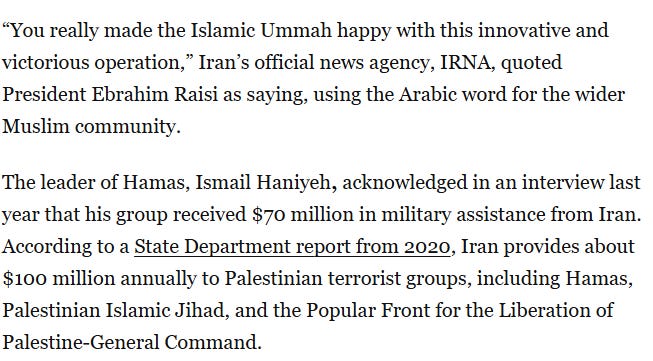
The Oct 7 attacks were so over the top that Israel didn’t just strike back at the Palestinians for a few weeks and then ratchet things back down to normal; it actually prompted the Israelis to take steps to dismantle Hamas. That meant blowing up tunnels under Gaza and obliterating every asset they had, which, since Hamas deliberately mixes civilian and military assets to prevent Israel from striking back, meant Israel had to level a big chunk of the Gaza Strip:
When Iran directed Hezbollah, the Syrian militias, and the Houthis to jump in and try to save Hamas, Israel gave them the same treatment. Even while Israel and America were stomping Iran into the ground, the Israelis were STILL laying a beatdown on Hezbollah until Trump told them to stop:
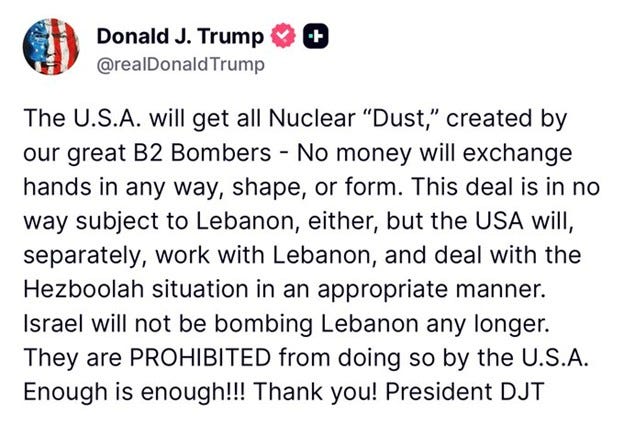
This is important because it stripped away a critical part of Iran’s defenses and left them in a fight alone against Israel and the US.
Of course, the hope was that this would never turn into a war.
The US and Israel hit Iran in “Operation Midnight Hammer” last year in an attempt to dramatically slow Iran’s nuclear program. In fact, Trump said we had “obliterated” it:

This has been a long-standing goal that Donald Trump has talked about over and over for at least the last 15 years.

As John Fetterman was honest enough to admit, Trump isn’t the only one who has been saying it either. Democrats have been tooting this same horn for a long time:

Of course, that raises an obvious question: How did we get from Trump saying we had obliterated their program (while many analysts were saying we may have just set it back a couple of years) to going to war over nukes? Israel’s disassembling Iran’s terrorist proxies certainly made the war possible, but what led to the actual fight?
This is where it gets interesting because Trump did not prepare the American public for a war, nor has he said EXACTLY why we had to go in now. However, there is an educated guess we can make based on publicly available facts.
Back in 2025, the IAEA said Iran had enriched uranium up to 60%. This is very important because there is no real civilian usage for that, and once you get to that point, with the right equipment, a nuclear bomb can theoretically be produced IN WEEKS.
So, it is entirely possible that when we hit Iran the first time, they were VERY CLOSE to getting a nuclear weapon. We may have “obliterated their program,” but that only set them back until they could rebuild it. As long as they could still access the enriched uranium, it meant they were still on the precipice of getting a nuclear weapon.
The other key detail here is that we were in talks with Iran about nuclear weapons before the war, and Trump publicly said that the talks were not going well:
So, what likely happened?
We’ve been talking to Iran about this issue for over a decade and getting nowhere. Then, we realized they were POTENTIALLY VERY CLOSE to nukes, and we concluded that our last-ditch efforts to talk this out had failed. So, at that point, Trump probably felt like he needed to act or accept that Iran was getting nuclear weapons. Granted, there might have been intelligence we haven’t seen or something Iran said in those talks that made us conclude it was “now or never,” but no matter how you slice it, we were running out of road fast. There was no way to know EXACTLY when Iran would have nuclear weapons, and if the decision to go in was punted three months, six months, or a year down the line, there is a genuine possibility that it may have been too late.
In any case, HOPEFULLY, the war is about to end, and we need to ask: Was it worth it? Well, it depends on what agreement we make with the Iranians.
If we take Iran’s enriched nuclear material away and they agree not to keep pursuing nukes, to no longer hamper trade through the Strait of Hormuz, and to stop sponsoring terrorist proxies in the region, it will be the biggest foreign policy coup for America since the Berlin Wall fell.
Will that happen? We don’t know for sure, although Trump seems to be optimistic about how things are going at this point:

Time will tell how it all plays out, but at the moment, it’s looking like Donald Trump is on track to pull off one of the most meaningful foreign policy victories since WW2.
Excellent summary. The key is that we really didn’t have a choice. Between the regime’s attempt at building nuclear weapons and the 100 or so missiles they were building every month, waiting longer would have only made the Iran problem harder to solve.
The perfect example of this dilemma is North Korea where we knew they have been building nuclear weapons for years yet and, despite saying “stop.” It’s now too late. Combine those weapons with intercontinental ballistic missiles and a messianic regime, the world is now at the mercy of a paranoid dictator.
Would allowing that to happen in Iran which, unlike NK, sits on a mountain of black gold, have been a good idea? I know I don’t think so.
Good Stack. An accurate summary. We’ll see is definitely the correct conclusion. A lot of variables.